User research for product and research teams
- Prospecting · Business Development
- Support analytics · Customer Service
- Social listening · Social Listening
- Community insights · Community Management
- Creative research · Content Strategy
- AI visibility · AEO/GEO Optimization
- User research · User Research
- Competitive intelligence · Competitor Intelligence
Turn every customer call into evidence the roadmap can use
Every interview, sales call, and survey, transcribed and coded to your codebook. Siftree ranks needs by share of calls and puts the quotes on the roadmap issue.
Ask from Claude, ChatGPT, or your own agent. Siftree connects the sources and runs the saved work.
User research
Needs board
- 12:04 Dispatchers rebuild the schedule by hand every time a tech calls in sick. Automatic re-routing
- 14:31 Invoices go out a week late because job notes are on paper. Mobile job notes
- 18:47 Customers keep calling to ask where the tech is. Live ETA for customers
- Automatic re-routing 24% FLD-214 · 12 quotes
- Live ETA for customers 18% FLD-231 · 9 quotes
- Mobile job notes 15% FLD-198 · 8 quotes
3 quotes coded · 14s
- Every call, transcribed
- Coded to your codebook
- Quote with timestamp
- Share of calls
- Linked to roadmap
- Quotes attached to issues
- Zoom
- Google Meet
- Call recordings
- Survey exports
- G2
- App Store
- Zendesk
- Linear
- Jira
- Notion
- Slack
From every call to the roadmap.
The synthesis a researcher does after each study, done on every call as it lands.
Interviews, sales calls, surveys, and reviews in one place. Recordings are transcribed on the way in.
Inbox · Fieldline research
| Source | Conversation | Length | Status |
|---|---|---|---|
| Interview Zoom | Brightline HVAC · Marcus T. | 42:18 | Transcribed |
| Interview Google Meet | Northgate Plumbing · office manager | 38:02 | Transcribed |
| Sales call Call recordings | Keystone Mechanical · discovery | 46:30 | Transcribed |
| Sales call Call recordings | Copperline Services · demo | 31:14 | Transcribing |
| Survey Survey exports | Q3 onboarding survey | 1,204 responses | Imported |
| Reviews G2 reviews | Fieldline on G2 | 86 new | Collected daily |
| Reviews App Store reviews | Fieldline Tech app | 142 new | Collected daily |
| Help desk Zendesk | Tickets tagged “feature request” | 311 tickets | Connected |
- Interviews and sales calls
- Surveys and reviews too
- Transcribed on arrival
- Reviews collected daily
Synthesis that keeps up with every call.
Each agent runs on a new recording or a schedule, shows its quotes, and waits for a person when you want it to.
-
Code every new call
- When
- An interview or sales call recording comes in
- Does
- Transcribes it, codes need, segment, and severity from your codebook, and pulls each quote with its timestamp.
- Writes
- Attaches the quotes to the matching issue
-
Evidence keeper
- When
- A need’s counts change
- Does
- Recounts the calls, segments, and quotes behind every linked roadmap item.
- Writes
- Updates the “Customer evidence” field
-
New-need watch
- When
- A need passes 10% of calls
- Does
- Posts the need, its share by segment, and three quotes.
- Writes
- Alerts #product
-
Research gap watch
- When
- Fridays at 9:00 am
- Does
- Finds needs heard on sales calls but never in research, with the accounts that raised them.
- Writes
- Asks #research to add them to the next study
-
Monthly synthesis
- When
- First Monday of the month, 8:00 am
- Does
- Writes the cited needs report and refreshes the quote bank, every quote with its timestamp.
- Writes
- Publishes it to the research wiki
-
Interview guide drafter
- When
- A need has sales evidence but under 5 interviews
- Does
- Drafts an interview guide and a recruit list from the accounts that raised it.
- Writes
- Saves the guide as a draft
Stop hand-tagging transcripts.
Tagging by hand covers one study at a time. Siftree codes every interview and sales call to one codebook as it lands.
| Today: Hand-tagging in Notion + clip hunting | With: User research |
|---|---|
| Tagging transcripts by hand, one study at a time | Every call coded to one codebook as it lands |
| Sales calls research never hears | Interviews and sales calls counted side by side |
| An afternoon hunting for one clip | Every quote with its timestamp, one search away |
| A readout deck nobody opens | Evidence on the issue the PM already reads |
| New needs noticed a quarter late | An alert when a need passes 10% of calls |
What a PM checks before planning, already done.
-
Every coded quote, searchable by need, segment, and severity, each one a click from its moment in the recording.
-
The quotes behind one roadmap bet, with accounts and timestamps, ready to paste into the PRD.
-
Thresholds you set, posted to Slack or email with the share of calls and the quotes behind it.
-
A cited monthly readout. Every claim links to the interview or call behind it, so nobody has to take it on faith.
★ In Q4 routing pack
“Dispatchers rebuild the schedule by hand every time a tech calls in sick.”
“Union rules make overtime assignment a nightmare.”
Every conversation in, evidence out.
Native connectors for your call recorder, help desk, and CRM, public reviews collected for you, and write-back to the roadmap.
- Zoom Recordings
- Google Meet Recordings
- Call recordings Call recorder
- Survey exports Surveys
- G2 reviews Reviews
- App Store reviews Reviews
- Google Play reviews Reviews
- Zendesk Help desk
- Intercom Help desk
- Salesforce CRM
- Linear Roadmap
- Jira Roadmap
- Notion Research wiki
- Slack Alerts
- Email Reports
- CSV / API Your systems
- Claude MCP
- ChatGPT MCP
The numbers your team already reports.
User research measures your own KPIs from the same labeled records, every week, with the source one click away.
User research
Dashboard
-
Time to synthesis
Days from the last interview to a shareable readout.
Last 12 weeks
-
Evidence per decision
Roadmap bets backed by coded customer evidence.
Last 12 weeks
-
Research reach
PMs and designers who query research themselves.
Last 12 weeks
-
Need coverage
Needs heard in sales or support that research has also explored.
Last 12 weeks
Yours to change. Just ask.
This workflow isn’t a fixed product. It runs on your rules and your data, and it changes when your team does.
- Change it by asking.
- Add a label, a rule, or an alert in a sentence. Siftree shows the change and waits for your approval.
- Read every rule.
- Scoring, labels, and triggers are saved in plain language, so anyone on the team can see why it did what it did.
- Keep the data.
- Every record lands in a database you own. Export it, or query it from Claude or ChatGPT through Siftree MCP.
User research
/ Change requestWeight each need by the ARR of the accounts that raised it, using Salesforce.
Proposed changes · 3
- Join ARR from Salesforce to every account on a call
- Needs board ranks by ARR as well as share of calls
- Add ARR to the “Customer evidence” field in Linear
- Add a competitor code
- Split needs by plan
- Code churn reasons
- Send the report to #design
Ways teams use Siftree.
Copy one into your Siftree-connected agent and swap in your own calls and codebook.
-
“Which unmet needs appear in more than 25% of interviews?”
→ Need ranking -
“How do enterprise and mid-market customers describe scheduling differently?”
→ Segment comparison -
“Find three quotes that support the Q4 routing bet.”
→ Quote pack -
“Which feature requests contradict what we heard in interviews?”
→ Conflict list -
“What words do customers use for the problem we solve?”
→ Language bank -
“Alert me when a new need shows up in 10% of calls.”
→ Alert
Before you connect your recordings.
Is Siftree the right tool for synthesizing customer interviews?
Siftree builds and runs a custom research synthesis workflow for product and research teams. It transcribes every interview and sales call, codes each quote to your codebook by need, segment, and severity, and attaches the evidence to the Linear or Jira issue it supports. It's the better choice if you want synthesis across every call, not only the ones a researcher had time to tag. If you run a few interviews a quarter, a transcription tool and a shared doc may be enough.
What can it change without a person?
Only what you allow. Each agent is set to run automatically, draft for review, or ask first, and every action is logged with the evidence behind it.
Who can see our data?
Access is scoped to the channel and the accounts you grant. Tasks run in an isolated sandbox, creating or running a task requires approval, and every action is written to an activity log.
Does it work with recordings, not just transcripts?
Yes. Siftree transcribes audio and video recordings, then codes them alongside existing transcripts and notes.
Can we keep our own codebook?
Yes. Paste your codebook or let Siftree propose one from a sample. Codes come from a fixed list, so counts are comparable across studies.
How do PMs use it without learning a new tool?
They ask from Claude or ChatGPT through Siftree MCP and get answers with quotes that link back to the source conversation.
Can we work from ChatGPT or Claude?
Yes. Connect Siftree to your supported client and ask it to work with your authorized data. Siftree stores the databases and runs saved tasks on a schedule, so the work can continue after the conversation ends.
Do we need engineers to set this up?
No. Connect your tools, describe what you want in plain language, and approve the setup before anything runs. Changing it later takes a sentence, not a ticket.
Make the right call for your team.
- Siftree research synthesis workflow vs Condens: research knowledge and product handoff
- Siftree research synthesis workflow vs Looppanel: interview analysis and coded evidence
- Siftree research synthesis workflow vs Dovetail: from interviews to product evidence
- Siftree research synthesis workflow vs Marvin: research collection, synthesis, and activation
- Condens alternatives for user research teams
- Dovetail alternatives for user research teams
- Looppanel alternatives for user research teams
- Marvin alternatives for user research teams
User research
Turn every customer call into evidence the roadmap can use.
- Cited. Every claim links to its source.
- Your call. Each agent runs on its own, drafts for review, or asks first.
- Sandboxed. Tasks run in an isolated sandbox.
- Scoped. Access limited to what you grant.
The Siftree suite
- Prospecting · Business Development
- Customer support · Customer Service
- Social listening · Social Listening
- Community insights · Community Management
- Creative research · Content Strategy
- AI visibility · AEO/GEO Optimization
- User research · You're here
- Competitive intelligence · Competitor Intelligence
Start with a template and your own question.
Explore a workspace, adapt a prompt, and put the workflow to work through your existing agent.
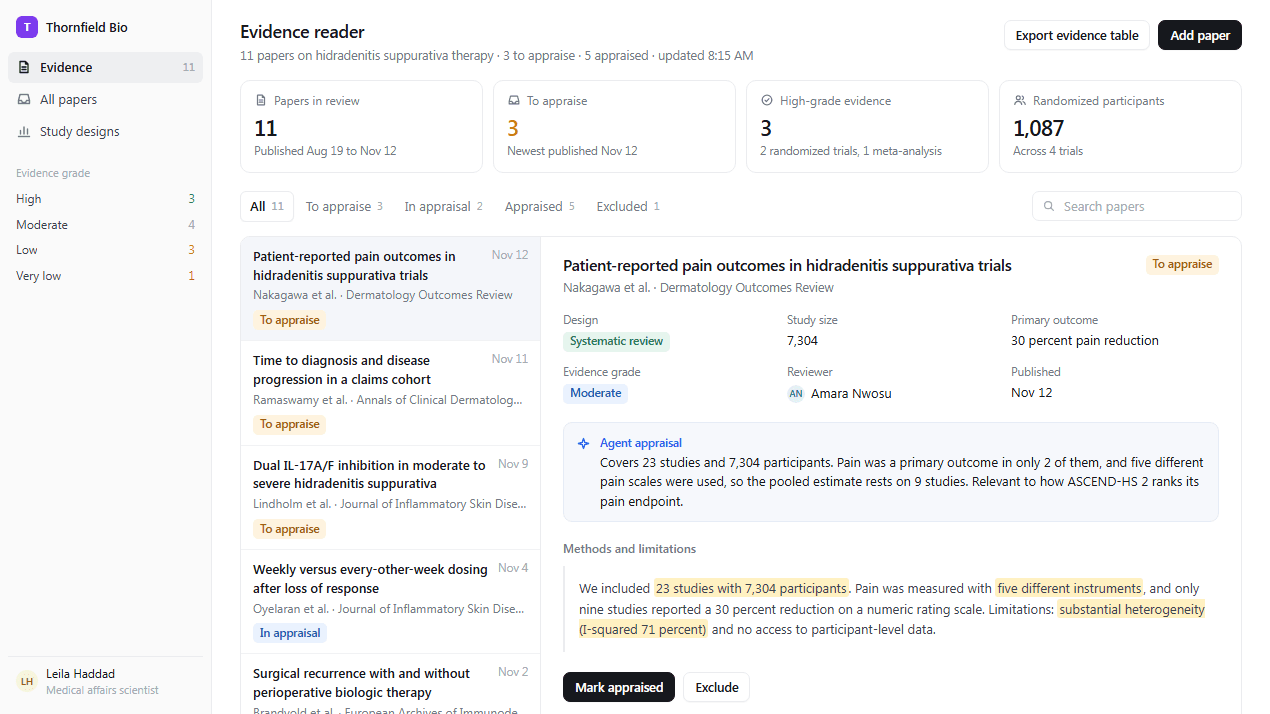
Research evidence explorer
Read reported methods and limitations, then retain an attributable evidence extraction.
Explore the template and starting prompt
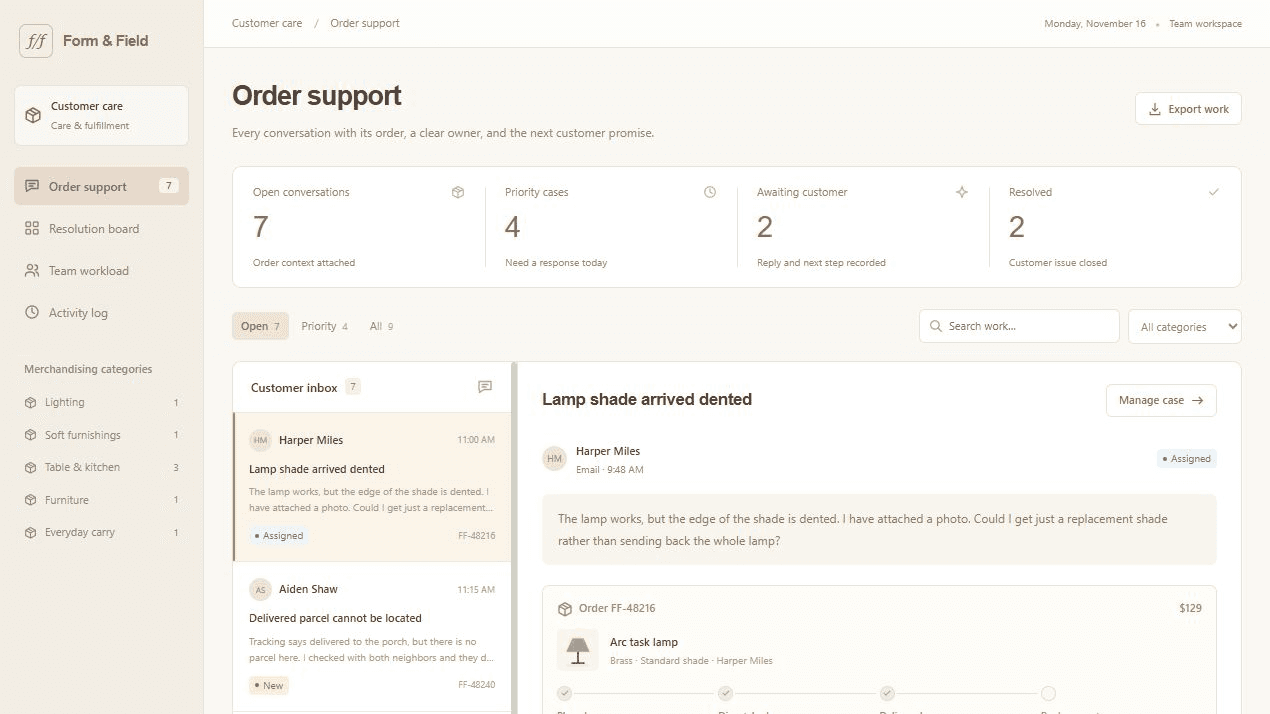
Customer support workspace
Resolve customer issues with the order in view. Review the conversation, assign the service owner, and approve a reply with the recovery steps attached.
Explore the template and starting prompt