Siftree social listening workflow vs Brandwatch: choose your social listening workflow
Compare Siftree social listening workflow and Brandwatch Consumer Research for social intelligence, source coverage, narrative analysis, evidence, and team alerts.


Should you choose Siftree social listening workflow or Brandwatch for social listening?
Prioritize Brandwatch Consumer Research when its historical archive, consumer research environment, and analysis tools match your research program. Consider Siftree social listening workflow when you want a recurring workflow that joins social posts, comments, and video or audio transcripts into narratives and routes changes to your team. Both use AI in their analysis. Test the platforms, formats, and languages your audience actually uses; a general source count does not establish coverage for your question.
How this workflow fits: Siftree is an AI-native IT department for your team. Ask for a social listening solution through your existing AI connected over MCP. Siftree builds and runs the solution within your budget, managing integrations, models, databases, hosting, and access controls. Explore the sources and connections for your workflow through the available integrations.
When a campaign phrase changes meaning
Listening tools are easy to compare on a quiet week. The real test is a campaign whose own words get turned against it. A claim starts as praise, gets quoted sarcastically, gets borrowed by a competitor, and ends up in complaint threads. Whichever tool you choose has to keep up with that change.
Both products can, in different ways. Brandwatch Consumer Research documents categorization rules for historical and future data, text uploads, image analysis, threshold email alerts and mention assignment. It is not a passive, text-only dashboard. Siftree social listening workflow collects posts, comments and video or audio transcripts, sorts them into the narratives you define, measures how the conversation shifts, and routes a spike to its owner with the evidence attached.
A launch claim turns from praise to complaint
Your launch line trends positively for three days. Then a creator quotes it sarcastically in a video, a competitor reuses the phrase, and comment threads start pairing it with a refund complaint.
| Stage | Brandwatch | Siftree social listening workflow |
|---|---|---|
| The phrase is collected | Searches and categorization rules apply to new data as it arrives | Posts, comments and video transcripts matching your brands and phrases are collected |
| Check: Is the sarcastic video retrieved at all, and from its speech or only its caption? | ||
| Meaning shifts | Custom Classifiers are retrained with new example mentions placed in categories | The narrative definitions are updated in plain language, and the next run applies them |
| Check: How many analyst minutes did the update take, and were older mentions recategorized? | ||
| Competitor borrows it | Query logic and categories need to separate your claim from the competitor's | The quoted competitor claim is filed under a separate narrative with its source |
| Check: Is the creator's claim kept apart from the comments responding to it? | ||
| Someone has to act | A threshold email alert or mention assignment reaches an analyst | A spike alert reaches the comms owner with the posts that explain it |
| Check: Can the recipient name the issue and an owner from the alert alone? | ||
A proposed study built from vendor documentation, not an observed result. Use the same period, brands and inclusion rules for both tools.
Classifiers are a skill your team keeps
Brandwatch's audience-analysis walkthrough describes training Custom Classifiers by placing mentions into categories. That control is valuable when a narrative doesn't map to generic sentiment. It also gives an analyst a standing job: curating examples and checking mistakes every time campaign language changes.
| Compare | Best fit | Ask before choosing |
|---|---|---|
| Brandwatch | Analysts exploring consumer conversations with searches, categories, rules, and image analysis. | What history and source access do we get, and who maintains the queries and classifiers? |
| Siftree social listening workflow | Start with posts, comments, and transcripts grouped into narratives, with evidence for a comms alert. | Which sources, brand definitions, alert rules, and response owners should our app use? |
Siftree entries describe the starting app. Additional sources, screens, and actions are scoped around your workflow and available data access.Source: linked vendor documentation.
See why a post belongs to a narrative
Mentions sorted into your narrative definitions, each linked back to its original post.
@dermdiaries
Transcript · 0:12–0:20
“Okay so Dewly gel cream, it balls up the second I put SPF on top. What happened?”
Also on the video: 2,140 comments, 18% mention Lumera
Labels
-
Brand
Tracked brands
Lumera Dewly Clarrabecause said “Dewly” at 0:16
-
Narrative
1 of 11 · your narratives
Wears well under makeup Pilling under makeup Price vs value Oily-skin fit Packagingbecause “balls up” + “SPF on top”
-
Sentiment
Fixed scale
Positive Neutral Mixed Negativebecause “what happened?”
What a fair Brandwatch quote includes
Choose Brandwatch when the Consumer Research environment suits a research program and analysts want to run segmentation and historical analysis. Evaluate Siftree when the deliverable is a defined narrative report and a spike brief someone can act on. Request terms against the same scope. Neither a setup estimate nor a coverage headline establishes a cost or coverage winner.
Checklist · 0 of 7
Ask both vendors to price the same scope
Comparing several platforms? See Brandwatch alternatives.
Which shopper conversations need a product or brand response?
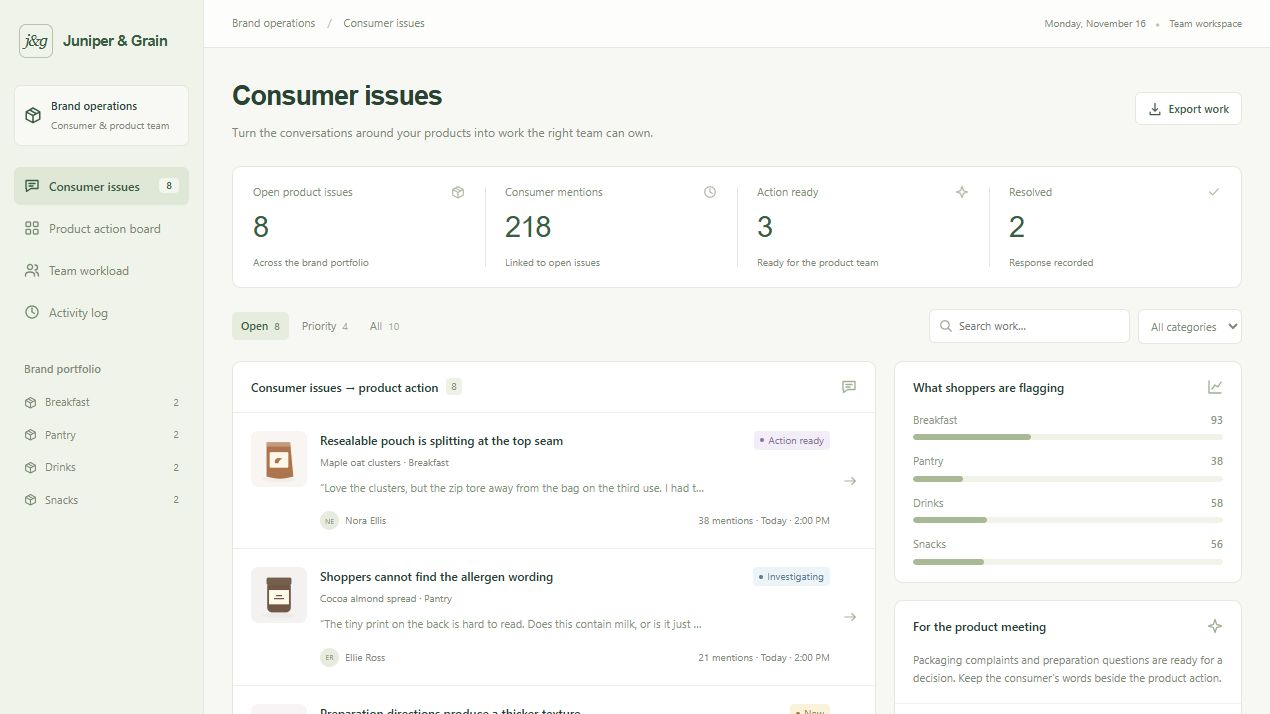
After comparing listening tools, follow one recurring shopper concern through to an assigned action. The social listening desk keeps the source conversation, product question, and next review together.
Frequently asked questions
Does Brandwatch analyze images?
Yes. Brandwatch Consumer Research's feature documentation lists image analysis alongside categorization rules, text uploads, threshold email alerts and mention assignment.
What are Brandwatch Custom Classifiers?
Custom Classifiers let analysts train categories by placing example mentions into them. They help when a narrative does not map to generic sentiment, and they need upkeep when campaign language changes.
How does Siftree social listening workflow handle a narrative that changes meaning?
You edit the narrative definitions in plain language, and the next run applies them to newly collected posts, comments and transcripts. Spikes are routed to the owner with the posts that explain the change.
Sources & methodology
Written by Kyle DeSana from the product documentation linked below. Recommendations describe workflow fit.

Co-founder, Siftree
Kyle co-founded Siftree after working in data across telecom, media, insurance, automotive, and entertainment and tourism. He writes Siftree's software comparisons and buying guides from the vendor documentation linked in each article.
See it with your own workflow.
Start with Social listening, or have us build around your team's workflow. Bring the data you use, the work you want done, and where the result should go. We'll scope the app and required access with you.