World Economic Forum: What Video Analysis from Davos 2026 Reveals That Headlines Didn’t
Case Study
A quantitative analysis of World Economic Forum 2026 sessions, benchmarked against global media coverage, to extract the strategic intelligence executives and capital allocators actually need.
Produced by Siftree Inc. and Babbl Labs. February 2026.
Executive Summary
The 56th Annual Meeting of the World Economic Forum convened in January 2026 in Davos-Klosters, Switzerland, drawing approximately 3,000 delegates from 130 countries, 830 corporate CEOs, and a record 400 political leaders including 65 heads of state.
This report is built on a dataset of ~20 hours of 2026 Keynote footage, pulled directly from the Official World Economic Forum’s YouTube Account, algorithmically clustered into distinct topic groups. We benchmarked these topic clusters against coverage from Bloomberg, the Financial Times, CNBC, The Guardian, The Washington Post, J.P. Morgan, Chatham House, Carnegie Endowment, and other major outlets to isolate the delta between what the press told the world and what global leaders actually spent their time discussing.
The gap is severe.
The media did not operate as a single entity; rather, it fractured into three mutually exclusive narrative silos. Mainstream outlets fixated on the political spectacle of the Board of Peace and tariff panics; institutional think tanks obsessed over legal architecture and systemic decay; and tech publications focused rigidly on AI logistics and EV market volatility. Because each silo actively ignored developments outside its narrow purview, relying on traditional reporting makes it nearly impossible to piece together an objective understanding of global events.
However, our transcript data reveals that the actual priorities of global leaders cut through this noise and were radically different. The data highlights structurally different, cross-cutting concerns: the physical energy constraints of AI deployment, the imminent restructuring of white-collar labor, the death of WTO-style multilateralism in favor of transactional “minilateral” corridors, and the hard pricing of nature risk into corporate supply chains.
Methodology
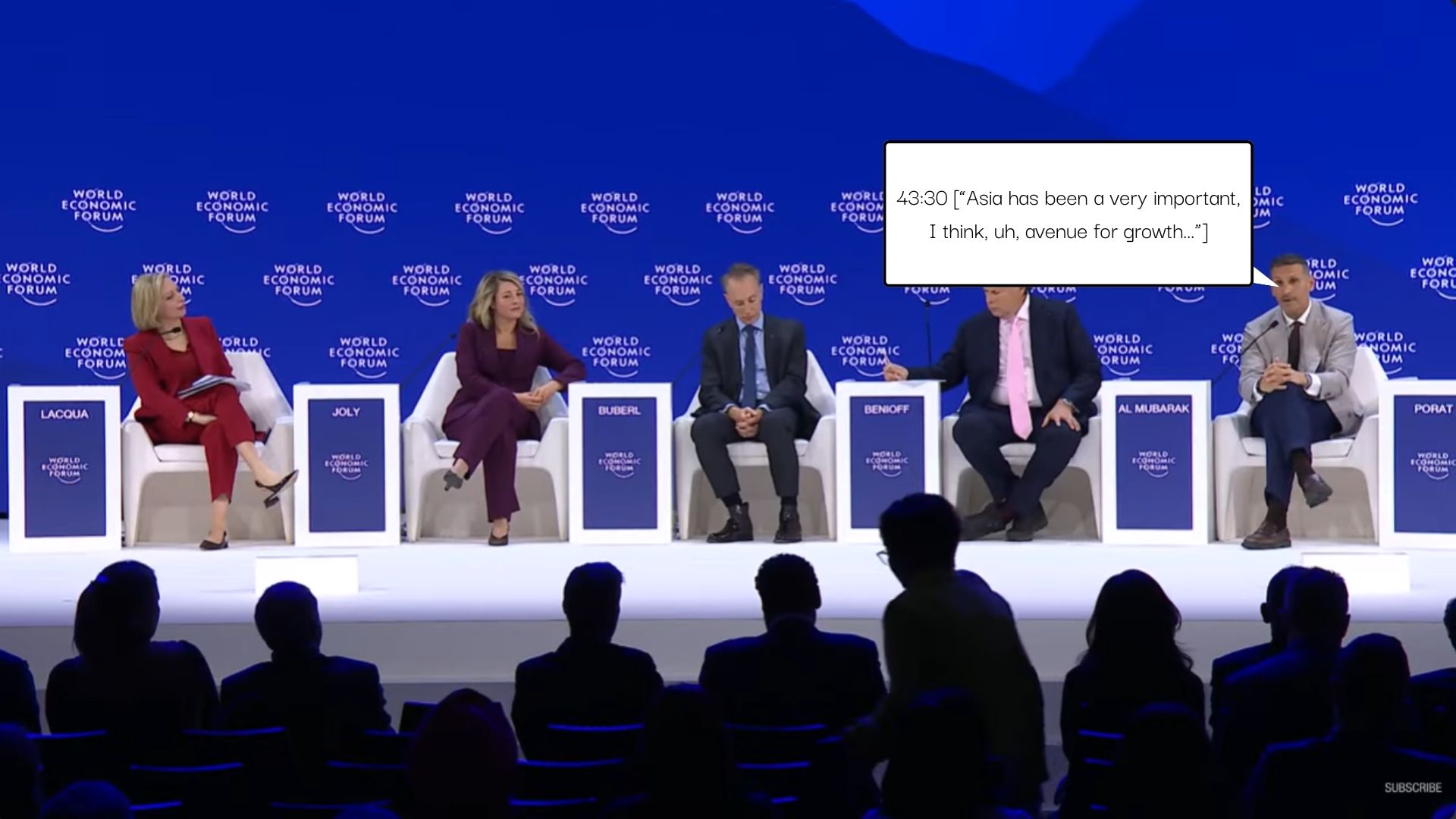
This report represents a collaboration between Babbl Labs (video data infrastructure) and Siftree (the analytical layer). We moved beyond headline analysis by "watching" and decoding hours of Davos session footage via AI-driven audio transcription. By quantifying the actual substance of these conversations and comparing them to traditional news cycles, we can highlight the specific "cost of silence" — the critical insights that were discussed on stage but stayed "undercover" in the media.
Why we did this
In today’s fragmented information ecosystem, relying on traditional news sources to dictate policy or capital allocation creates a dangerous epistemic blind spot. The risk isn’t merely getting delayed information, but receiving a structurally distorted version of reality filtered through algorithmic biases and editorialized silos.
In competitive markets, waiting two weeks for a post-event analyst report to manually untangle these conflicting narratives is a massive liability. By utilizing topic clustering directly on the raw keynote footage and transcripts, our pipeline bypasses journalistic filtering entirely. While the mainstream media was debating the theatricality of the "Board of Peace," our systems were able to identify the 45% surge in copper demand and the AI "Energy Wall" in near real-time. We do not ask what the press said happened; we measure what leaders actually discussed, extracting the ground-truth data and core insights buried deep within hours of footage.
The Advantage
For funds, this means moving from "anecdotal evidence" to "quantified discourse" in hours, not weeks. We turn thousands of hours of raw video into a structured data layer, allowing you to identify shifts in capital flow and infrastructure bottlenecks while your competitors are still reading the morning headlines.
This Davos report is a proof-of-concept for a new standard of intelligence. The same pipeline — Babbl’s high-fidelity transcription and Siftree’s inductive intelligence layer — can be deployed for your specific industry, vertical, or niche every single day.
Whether it’s tracking a specific competitor's earnings calls, monitoring a regional regulatory shift in Congressional hearings, or decoding a fragmented technological landscape, we can provide a near-real-time "Signal-vs-Noise" dashboard. In summary: don’t track the news; decode the data that creates it.
For enterprise leaders and institutional investors, this report distills the actionable signal from the noise produced by the media.

Key observation: The single largest cluster by document count is Nature & Corporate Integration at 163 segments — over three times the volume dedicated to Gaza or tariffs. The media barely mentioned it.
Full report available: Start reading now for free
Our complete report includes the full list of top topics, eight critical themes the media overlooked, and 6 core findings that were emphasized across keynote speakers but missed by mainstream media.