What Is a Semantic Layer and Why Do AI Agents Need One to Be Accurate?
Tech
You ask two AI agents the same question: "What was our gross margin last quarter?" One returns 42%, the other returns 38%… How? Both are pulling from your company's data. Neither is hallucinating, they're just interpreting "gross margin" differently —one includes shipping costs, the other doesn't, one uses COGS from the finance team's definition, the other uses the ops team's version.
This isn't an AI problem. It's a meaning problem. And it's the exact problem that semantic layers were designed to solve —decades before anyone was building autonomous agents.
The Core Idea: One Definition, Everywhere
A semantic layer is an abstraction that sits between raw data and the people (or machines) consuming it. It translates the physical reality of your database — table names, column IDs, join logic, aggregation rules — into business concepts that humans and software can work with consistently.
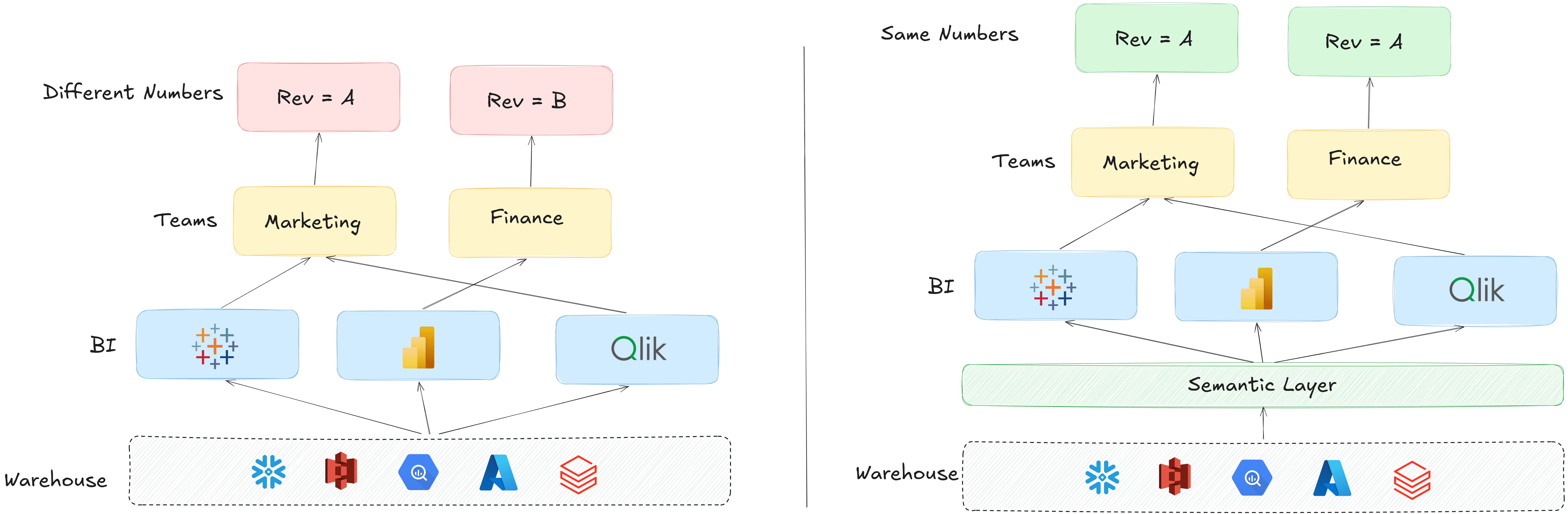
Instead of letting every dashboard, report, notebook, and now every AI agent re-derive what "revenue" or "active customer" or "churn rate" means from raw tables, you define it once in the semantic layer. Every downstream consumer — Tableau, Power BI, a Python notebook, an LLM-powered copilot — gets the same answer because they're all resolving against the same governed definition.
The concept is deceptively simple. The consequences of not having one are severe, and they compound the moment you hand data access to an autonomous system that can't call a meeting to reconcile conflicting numbers.
This Is Not a New Idea
The semantic layer has deep intellectual roots. The underlying problem—how do you create shared, formal definitions of concepts so that different systems (or people) can reliably communicate about the same domain?—has been studied for decades.
The Philosophical Foundation: Gruber's Ontologies
In 1995, Thomas R. Gruber (who would later co-create Siri) published a foundational paper at Stanford on the design principles for formal ontologies used in knowledge sharing in light of recent work in Artificial Intelligence. His core argument was that when multiple software agents need to communicate and share knowledge, they need explicit, agreed-upon definitions of the concepts in their domain. He called these shared conceptualizations ontologies, and proposed five design criteria that remain remarkably relevant: clarity (definitions should be objective and unambiguous), coherence (the formal definitions should be logically consistent with informal descriptions), extendibility (you should be able to add new concepts without revising existing ones), minimal encoding bias (definitions shouldn't depend on a particular implementation), and minimal ontological commitment (the ontology should say only what's necessary, leaving room for different agents to specialize).
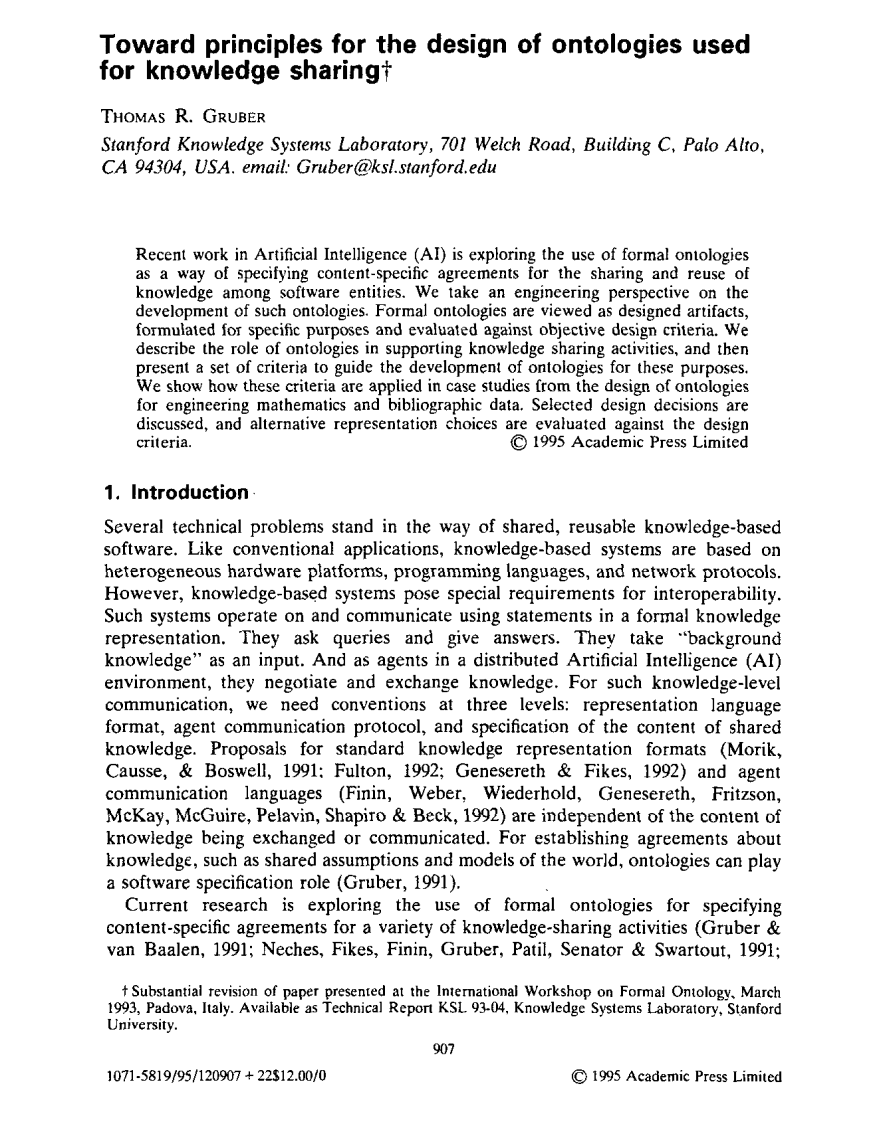
Gruber demonstrated these principles through a case study in engineering mathematics. The naive approach — defining a physical quantity as a number paired with a unit — seemed intuitive but turned out to be incoherent. Six feet and two yards, under that definition, weren't the same quantity. It took multiple iterations of the ontology, introducing concepts like physical dimensions and unit-independent magnitude functions, to create a representation that was both logically sound and extensible.
The parallel to modern data infrastructure is striking. When your finance team defines "revenue" one way in their spreadsheet and marketing defines it differently in their dashboard, you have exactly the incoherence problem Gruber identified. When an AI agent tries to work with both definitions simultaneously, it produces the same kind of contradictory results his early ontology versions did.
Business Objects: The First Commercial Semantic Layer
While Gruber was formalizing the theory, the commercial world was independently arriving at a similar solution. Business Objects, founded in France in 1990 and later acquired by SAP, introduced the concept of a Universe, a metadata layer that mapped the technical structure of databases (tables, columns, joins) to business-friendly terms that non-technical users could drag and drop into reports.
The Universe was, functionally, a semantic layer. It hid SQL complexity behind objects like "Customer," "Revenue," and "Region." It defined aggregation rules, joins, and filters centrally. It meant that a business analyst didn't need to know that "revenue" was actually SUM(order_line.unit_price * order_line.qty * (1 - order_line.discount)) across three joined tables, they just selected "Revenue" from a folder, and the Universe generated the correct SQL.
This was the 1990s. The problem SAP Business Objects solved — different users getting different answers from the same data because they wrote different SQL — is the same problem that enterprises face today with AI agents generating their own queries.
OLAP and the Multidimensional Precedent
Around the same time, OLAP (Online Analytical Processing) systems like Microsoft Analysis Services, Hyperion Essbase, and Cognos introduced multidimensional cubes that pre-defined measures, dimensions, hierarchies, and calculated members. These cubes were semantic layers in all but name: they defined "what can be measured" and "how it can be sliced" in a governed, centralized way. Users interacted with business concepts; not raw data.
The pattern is consistent across three decades: every time organizations needed to scale consistent, trustworthy analytics across multiple consumers, they ended up building something that looks like a semantic layer.
Why AI Agents Made This Urgent Again
For years, semantic inconsistency was manageable. Humans consuming dashboards could spot obviously wrong numbers, ask clarifying questions, and reconcile discrepancies in meetings. The cost of ambiguity was friction, such as extra emails, quarterly reconciliation sessions, footnotes on reports.
Generative AI broke this tolerance model.
When an LLM writes its own SQL to answer a business question, it has no institutional knowledge of how your company defines its metrics. It doesn't know that "active customer" at your organization means "placed an order in the last 90 days, excluding internal test accounts." It doesn't know that your COGS calculation excludes inbound freight for the North American segment but includes it for EMEA. It infers table structure from column names and metadata, constructs a plausible query, and returns a confidently presented number that may or may not match what any team in your company would consider correct.
This is worse than getting no answer. A wrong answer delivered with confidence erodes trust in the entire AI investment, and once trust is lost, it's extraordinarily expensive to rebuild.
The compounding factor is autonomy; a human analyst producing a wrong number gets corrected in a review meeting, but an AI agent operating autonomously — executing workflows, triggering alerts, feeding numbers into downstream systems — can propagate a bad definition across the organization before anyone notices.
Semantic layers give AI agents what they fundamentally lack: business context. When an agent resolves a question against a governed semantic model rather than writing ad-hoc SQL against raw tables, the answer is deterministic. It's the same answer a human would get from a dashboard built on the same model. It's auditable (you can trace exactly which definition and which logic produced the result) and it's consistent across every tool and agent in the stack.
How a Semantic Layer Actually Works
At its core, a semantic layer defines three things:
Entities and relationships. The business objects in your domain (Customers, Orders, Products, Campaigns) and how they connect. This is the conceptual model—the ontology, in Gruber's terms.
Metrics and measures. Named, governed calculations with explicit aggregation logic, filters, and time semantics. "Net Revenue" is defined once as SUM(gross_revenue * (1 - discount)) with a specific grain, specific inclusion/exclusion rules, and specific time-series behavior.
Policies and access controls. Who can see what data, at what granularity, under what conditions. Row-level security, data masking, and role-based access are encoded in the semantic layer rather than reimplemented in every downstream tool.
When a consumer — whether it's Tableau, an Excel pivot table, or an AI agent via MCP — asks a question, the semantic layer translates that question into optimized SQL that runs against your data warehouse. The consumer never touches raw tables directly. The semantic layer is the intermediary, and it enforces consistency by design.
The Modern Landscape: Where Should the Semantic Layer Live?
This is where the current industry debate gets interesting. Everyone agrees that a semantic layer is necessary. Nobody agrees on where it should sit in the stack. Three distinct philosophies have emerged, each with real tradeoffs.
Philosophy 1: It Lives in the Data Warehouse
Proponents: Snowflake, Databricks
Snowflake introduced Semantic Views in mid-2025—schema-level objects that define business metrics, dimensions, and entity relationships directly inside Snowflake. Databricks followed with Metric Views, governed through Unity Catalog. Both are defined declaratively in YAML and integrate with their respective AI assistants (Cortex Analyst and Lakehouse).
The argument: Semantics should live as close to the data as possible. If your warehouse already governs access, lineage, and compute, the semantic layer is a natural extension of that governance. It reduces architectural complexity—one fewer system to manage—and the tight integration with the warehouse's query engine enables performance optimizations that an external layer can't easily replicate.
The tradeoff: Platform lock-in. Snowflake's Semantic Views only work inside Snowflake. Databricks' Metric Views only work inside Databricks. If your organization uses both (or plans to migrate, or acquires a company on a different stack), you're maintaining parallel semantic definitions—which is exactly the fragmentation semantic layers were supposed to eliminate.
Philosophy 2: It Lives in the BI Tool
Proponents: Power BI (Microsoft Fabric), Tableau, Looker (LookML)
Power BI's semantic model (formerly called a "dataset") is arguably the most feature-rich BI-native semantic layer on the market. It defines measures in DAX, enforces row-level security, manages relationships, and serves as the single source of truth for every report built on that model. Microsoft's Fabric platform extends this further with Direct Lake mode and AI Copilot integration. Tableau and Looker take similar approaches with their own modeling languages.
The argument: The semantic layer is fundamentally a BI concern—it exists to make analytics trustworthy. BI tools are where business users live, so that's where business definitions should be managed. Power BI's semantic model, for instance, can be versioned in Git, deployed through CI/CD pipelines, and consumed by third-party tools via XMLA endpoints.
The tradeoff: BI-tool lock-in. If your organization uses Power BI and Tableau (which is extremely common in large enterprises), each tool maintains its own semantic model. The definitions can drift. And critically, these BI-native semantic layers weren't designed to serve AI agents—they were designed to serve dashboards. Extending them to agentic workflows requires additional integration work.
Philosophy 3: It Lives Independent of Both
Proponents: AtScale, Cube
This camp argues that the semantic layer should be a standalone, platform-neutral component that sits between your data sources and all downstream consumers—BI tools, notebooks, AI agents, custom applications. You define metrics once, and the semantic layer serves them consistently to Tableau, Power BI, Excel, Python, and LLM-powered agents through a universal API.
AtScale, founded over 12 years ago, has been building this vision the longest. Their approach exposes governed semantic models through multiple protocols (SQL, MDX, DAX, REST, and now MCP) so that any consumer can interact with the same definitions without the semantic layer being coupled to a specific warehouse or BI tool. Cube, originally an open-source project that started as a side project to make a Slack chatbot return consistent answers, takes a code-first approach with YAML-based model definitions, a built-in caching/pre-aggregation layer, and a comprehensive API surface (REST, GraphQL, SQL, MDX, DAX, and a dedicated AI API).
The argument: Enterprises inevitably operate multi-cloud, multi-warehouse, multi-BI-tool environments. Tying semantic definitions to any single platform recreates the fragmentation problem at a different layer. An independent semantic layer lets you swap out your warehouse, change your BI tool, or add new AI agent frameworks without redefining your business logic.
The tradeoff: Additional infrastructure to deploy and manage. Organizations that are genuinely single-platform (all-in on Snowflake, or deeply embedded in the Microsoft stack) may find the operational overhead harder to justify compared to a native option.
Why This Matters Beyond AI
The AI agent use case is grabbing headlines, but the benefits of a governed semantic layer are broader and more fundamental:
Cross-team alignment. When finance, marketing, and operations all pull from the same semantic model, "revenue" means the same thing in every meeting. This sounds trivial. In practice, metric reconciliation consumes an astonishing amount of senior leadership time at most large organizations.
Faster onboarding. A new analyst exploring the semantic layer sees business-friendly names, descriptions, and pre-built metrics—not raw table schemas. The ramp from "new hire" to "productive contributor" compresses significantly.
Reduced maintenance burden. When a metric definition changes (e.g., your company changes how it calculates churn), you update it in one place. Every report, dashboard, agent, and application that consumes that metric inherits the change automatically.
Performance optimization. Semantic layers like AtScale and Cube include caching and pre-aggregation engines that sit between the consumer and the warehouse. Repeated queries—especially common in AI agent workflows where the same question might be asked thousands of times across users—resolve against cached aggregates instead of triggering full table scans.
Governance at scale. Row-level security, data masking, and access policies defined once in the semantic layer apply uniformly across every downstream consumer. An AI agent gets the same access restrictions as a human analyst—without the data team needing to re-implement those rules in every new tool or integration.
The State of Play in 2026
Gartner elevated the semantic layer to essential infrastructure in the 2025 Hype Cycle for BI and Analytics. Snowflake and Databricks have both shipped native semantic capabilities. Cube and AtScale were both named Leaders in the 2025 GigaOm Radar for Semantic Layers. The Model Context Protocol (MCP), an open standard for connecting AI agents to external data sources, has been adopted by Anthropic, OpenAI, Google, and Microsoft—and semantic layer vendors are shipping MCP integrations to give agents structured, governed access to business definitions.
The question is no longer whether you need a semantic layer. It's where it should live, who should own it, and how quickly you need to get one in place before your AI investments start compounding on inconsistent definitions.
The organizations that recognized this early—that treated semantic modeling as infrastructure rather than a nice-to-have—are the ones deploying AI agents with confidence. Everyone else is still reconciling numbers in meetings.
The semantic layer isn't a new invention. It's a very old idea whose time has, finally and urgently, come back around.