What an AI agent may do on a claim without adjuster approval
Which claim tasks an AI agent can run on your rules, and which coverage, reserve, and settlement decisions stay with the adjuster, drawn from the NAIC model claims regulation as a starting template.

What should an AI agent be allowed to do on a claim without adjuster approval?
Let an agent run administrative steps on rules your team writes: acknowledging a new claim in approved wording, requesting documents on your evidence list, following up, and filing what arrives. Coverage, reserve, settlement, and denial decisions, and any message that explains the policy, stay with the adjuster. The NAIC model regulation's timing duties, such as acknowledging a claim notice within 15 days, are a useful template, but states adopt their own versions. The line moves when your state's version or your carrier's authority limits say otherwise; check both with your compliance team.
What Siftree is: an AI-native IT department for your team. Describe the outcome through your existing AI connected over MCP, and we manage data integration, the data and AI platform, app and agent cloud, and security. This article compares platforms from their public documentation; check the sources, plans, and integrations against your own requirements.
Chasing paperwork is administration; deciding the claim is not
Acknowledgements, requests from an approved evidence list, follow-ups and filing can be candidates for administrative automation. They still need rules appropriate to the claim and jurisdiction. A request that requires interpreting the policy, deciding relevance or waiving evidence goes to the adjuster. Your team defines which routine messages may run without individual approval and which must stop for review.
The decisions are different. Whether a loss is covered, what to reserve, what to offer, and whether to deny belong to the adjuster or supervisor, and so does any message that explains what the policy says. The line is not about how hard a task is. It is about whether the task commits the carrier to a position on the claim.
The agent may act on your rules
- Acknowledge receipt of a new claim notice, in wording your team approved
- Request documents on your evidence list for that line of business
- Send claim forms your team has listed for the line
- Follow up on outstanding requests on a schedule
- File arriving documents to the evidence file and note what came in
- Alert the supervisor when a decision date is close and evidence is missing
The adjuster decides
- Whether the loss is covered
- The reserve, and any change to it
- The settlement amount and any offer
- A denial, and the reasons given for it
- Any reply that explains or interprets the policy
- Whether a disagreement between documents matters, and whether a document can be waived
Where the claim-handling clock comes from
Timing is the reason administration is worth automating, and the timing comes from claim-handling rules. The NAIC publishes model laws that states can adopt, often with their own changes. They are templates, not the law in any particular state, so read what follows as a starting point for your compliance team, not as legal advice.
The model regulation's section 6 is a reference for defining the workflow, not a substitute for the state's adopted requirements. Its acknowledgement exception, non-written record requirement and reply scope should stay attached to any timing rule you use.
The companion NAIC model act (#900), which states may adopt with changes, addresses prompt acknowledgement in section 4B. Section 4M addresses providing necessary claim forms within 15 calendar days of a request, with reasonable explanations of their use. Section 4A addresses knowing misrepresentation of claim facts or relevant policy provisions. These provisions do not establish that any particular automated request is appropriate; your team must review the applicable rules and approved wording.
Siftree keeps requests, follow-ups and replies in its databases but does not write to your claims system. Your procedure should say how required records reach the insurer's claim file, including the model's dated notation for a non-written acknowledgement if that provision is part of the applicable state rules.
Rules to agree before the agent sends anything
Checklist · 0 of 8
Write these down before any message goes out without review
Each rule turns a judgment your adjusters make today into an instruction the agent follows. Anything the rules do not cover goes to an adjuster.
One claim, two kinds of work
On the claims review desk, Tidewater Marine Supply's warehouse roof collapse, claim CL-48217, shows both sides of the line. The loss notice names the roof deck and the racking; the contractor estimate covers only the roof deck. Requesting the structural engineer report and the racking inventory is administration, and the agent can send both requests under the rules above. Whether the racking is covered, and what to reserve for it, is Dana Whitfield's decision as the adjuster. The agent shows her that the estimate and the notice disagree; it does not say what that means for the claim.
Which requests have gone out, and which claims are waiting on an adjuster's decision?
The claims review desk, with every open claim by stage, the evidence file on each one, and the requests the agent has sent. Connect the Gmail or Outlook inboxes the requests go out from and DocuSign for forms that need a signature.
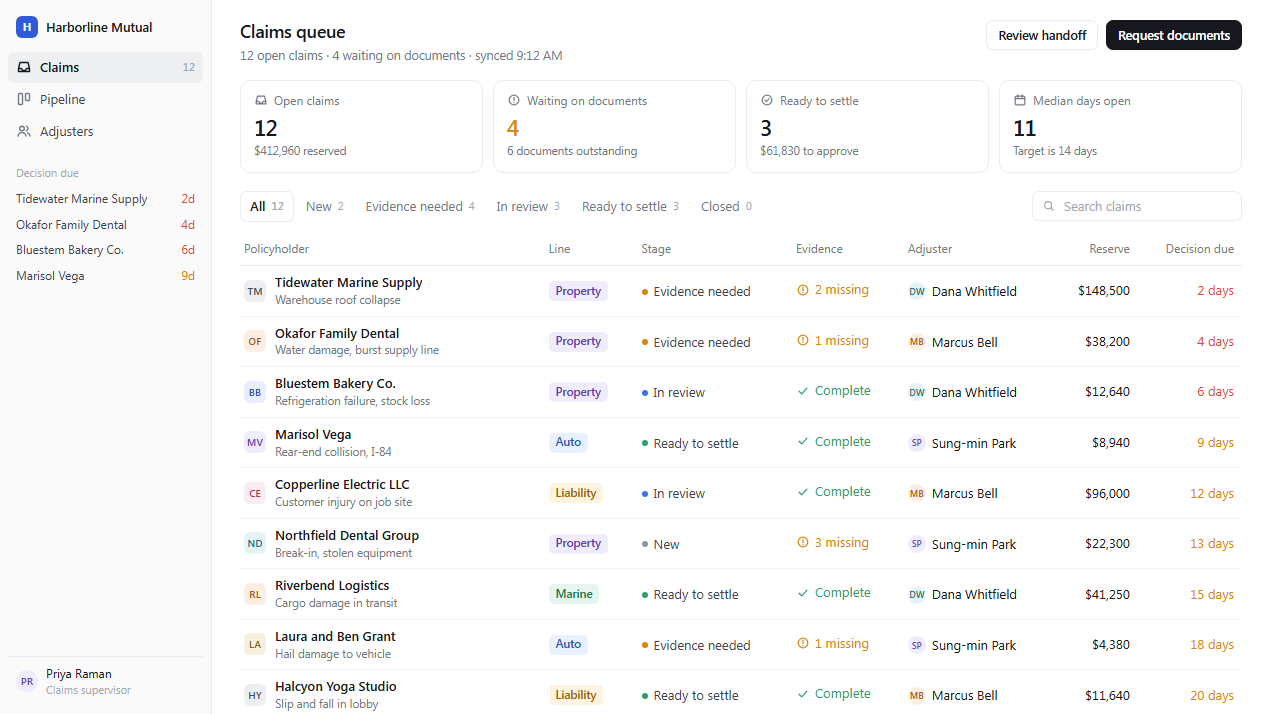
See how the claims evidence review desk keeps document requests moving while adjusters decide, or start from the claims review desk template.
Frequently asked questions
Can an AI agent acknowledge a claim on its own?
It can send an acknowledgement in wording your team approved, through Gmail or Outlook. Your procedure should say how the acknowledgement is noted in your claims system, because Siftree does not write to it.
Can an agent decide coverage or set reserves?
No. Coverage, reserves, settlement, and denials stay with the adjuster or supervisor. The agent lists what is missing and flags where documents disagree.
Is the 15-day acknowledgement rule the law in my state?
Not necessarily. The 15-day terms come from an NAIC model regulation, which states adopt in their own versions. Check your state's version with your compliance team.
What should the agent do when a claimant asks about coverage?
Hand the message to the adjuster. Explaining the policy is a decision about the claim, not administration.
Can the agent send forms for signature?
Yes, through DocuSign under your rules, and it tracks each envelope's status on the evidence file.
Sources & methodology
Product details and supporting references used in this guide.

Co-founder, Siftree
Kyle co-founded Siftree after working in data across telecom, media, insurance, automotive, and entertainment and tourism. He writes Siftree's software comparisons and buying guides from the vendor documentation linked in each article.
See it with your own workflow.
Connect your agent, or have us build around your team's workflow. Bring the data you use, the work you want done, and where the result should go. We'll scope the app and required access with you.