AI for claims adjusters when you already run Guidewire, Duck Creek, or Snapsheet
Compare documented Snapsheet and Duck Creek AI with Guidewire's dated ClaimCenter brochure, then check whether an added evidence workflow would fill a real gap in your claims setup.

What AI tools help claims adjusters if we already run Guidewire, Duck Creek, or Snapsheet?
Start with your claims platform's own tools. Snapsheet describes claim review tasks, and Duck Creek documents conversational intake and document intelligence. Check whether your configuration also collects evidence from broker email, shared folders and signed forms. Add Siftree when that collection and follow-up still need an owner. A platform can flag a required document as missing even before it arrives; the question is whether your setup can find and attach it. If the existing workflow already does that, improve it before adding another tool.
What Siftree is: an AI-native IT department for your team. Describe the outcome through your existing AI connected over MCP, and we manage data integration, the data and AI platform, app and agent cloud, and security. This article compares platforms from their public documentation; check the sources, plans, and integrations against your own requirements.
Platform AI works on the evidence the platform holds
A core claims system is where a claim's record lives. Snapsheet and Duck Creek describe AI for that work; Guidewire's 2020 ClaimCenter brochure describes intake, document upload and analytics. Start with the tools and connections available in your existing configuration. A required-document check can flag a report as absent before anyone files it. Finding the report in another channel and attaching it is a separate job; confirm how your system handles both.
A broker may forward an estimate by email, a policyholder may put photos in a shared folder, and an authorization may return through e-signature. The platform or its integrations may already collect those documents. Test the actual path before assuming they cannot. An agent layer is worth considering when collection and follow-up still happen by hand despite the tools you have.
What each vendor's pages describe, job by job
The matrix lists only what each vendor's own pages say, checked on November 16, 2026. For Guidewire, the source is the ClaimCenter brochure, published June 15, 2020, so its entries describe that document rather than the current product. A dash means the page we read does not document it, not that the feature is missing.
| Compare | Snapsheet | Duck Creek | Guidewire ClaimCenter |
|---|---|---|---|
| Intake and first notice of loss | Not documented in the sources we checked | Agentic FNOL: conversational intake and workflow orchestration | Adaptive FNOL process (2020 brochure) |
| Reading long documents | Document Assistant Navigator: a scannable brief, with values mapped to fields | Document Intelligence: unstructured documents to data and workflows | Not documented in the sources we checked |
| Customer document upload | Not documented in the sources we checked | Not documented in the sources we checked | Customers upload photos and documents (2020 brochure) |
| Review tasks on a file | WatchDog creates and assigns a review task when the file falls short | Not documented in the sources we checked | Not documented in the sources we checked |
| Triage | Not documented in the sources we checked | Not documented in the sources we checked | Analytics for triage and severity escalation (2020 brochure) |
| Claim file recaps | Instant recaps of full claim files | Not documented in the sources we checked | Not documented in the sources we checked |
| Evidence arriving in email or shared drives | Not documented in the sources we checked | Not documented in the sources we checked | Not documented in the sources we checked |
Not documented in the sources we checkedSource: linked vendor documentation.
Snapsheet's AI page says WatchDog "creates (and assigns) a review task when the file falls short", and that teams can "create review tasks only when the claim outcome is at risk (or outside of your guidelines)". Its Document Assistant Navigator turns "dense documents like medical records, police reports, and complex estimates into a scannable brief in seconds", with extracted values mapped to fields that users accept, edit, or reject. The page lists no plans or prices. For contents claims, Snapsheet describes an integration in which "claimtouch picks up each Coverage C claim the moment it opens in Snapsheet" and adds: "Payments and supporting documentation flow back into Snapsheet automatically."
Duck Creek's Agentic First Notice of Loss page describes conversational intake and workflow automation. Its Document Intelligence page describes extracting and summarizing information from insurance documents. The claims product page also describes rules-based routing by coverage, expertise and workload; the matrix does not classify that as a separately named AI triage product.
Guidewire's 2020 brochure describes ClaimCenter as supporting "all lines of personal, commercial, and workers' compensation insurance", with "an adaptive first notice of loss (FNOL) process", the ability for customers to "upload photos and documents", and analytics deployments including "claims triage, severity escalation, subrogation detection". Ask Guidewire which of these, and which newer AI features, apply to your version.
The reviewed descriptions do not settle how your configuration collects evidence from each external inbox or folder. Ask each vendor to demonstrate the path you need, including any existing integrations, rather than treating that gap in the reviewed material as a missing capability.
Which one fits your situation
- Snapsheet is the better choice when you already run Snapsheet Claims and want a review task raised inside the platform when a file falls outside your guidelines, plus document briefs whose values your adjusters accept or reject field by field.
- Duck Creek is the better choice when you run Duck Creek and want conversational first notice of loss and document intelligence inside the core claims system.
- Guidewire ClaimCenter is the better choice when you need core claims administration across personal, commercial, and workers' compensation lines in one system. Confirm its current AI features with Guidewire before you budget.
Deciding whether to add an agent layer
The question is where your evidence arrives and who sorts it. If brokers upload through a portal and policyholders submit through the platform, the platform's AI already sees the file. If the estimate, the photos, and the signed forms arrive by email and shared folders, someone is chasing and filing them by hand, and that is the work an agent layer takes on.
Keep to the platform's AI when
- Policyholders and brokers submit evidence through the platform's own intake
- Your adjusters already work review tasks and document briefs inside the platform
- The documents you need are already attached to the claim when review starts
- You want one vendor accountable for the claim record and its AI
Add an agent layer when
- Estimates, reports, and photos arrive in broker and policyholder email
- Claim documents sit in Google Drive, Box, or Dropbox folders outside the platform
- Signed releases and forms come back through DocuSign
- Someone on the team spends the day finding attachments and chasing what has not arrived
- You want document requests drafted or sent as soon as a gap appears
Siftree fits on the right-hand side. It reads claim evidence from Gmail and Outlook, from Google Drive, Box, and Dropbox, and from DocuSign envelopes, through connectors in Siftree's integration catalog. It lists what each file is missing, flags where documents disagree, and drafts or sends document requests from email under rules your team sets. It runs on a schedule, so outstanding requests are followed up and supervisors are alerted when a decision date is close.
Siftree has no Guidewire, Duck Creek, or Snapsheet connector. It does not update claims in those systems; your adjusters record stages and decisions there, and coverage, reserve, and settlement decisions stay with them. See how the claims evidence review desk works alongside a core claims system.
Which claims are still waiting on evidence that arrived outside the claims system?
The claims review desk, with every open claim by stage and an evidence file showing what is in and what is requested. Connect the Gmail or Outlook inboxes where broker email arrives, the Google Drive, Box, or Dropbox folders that hold claim documents, and DocuSign.
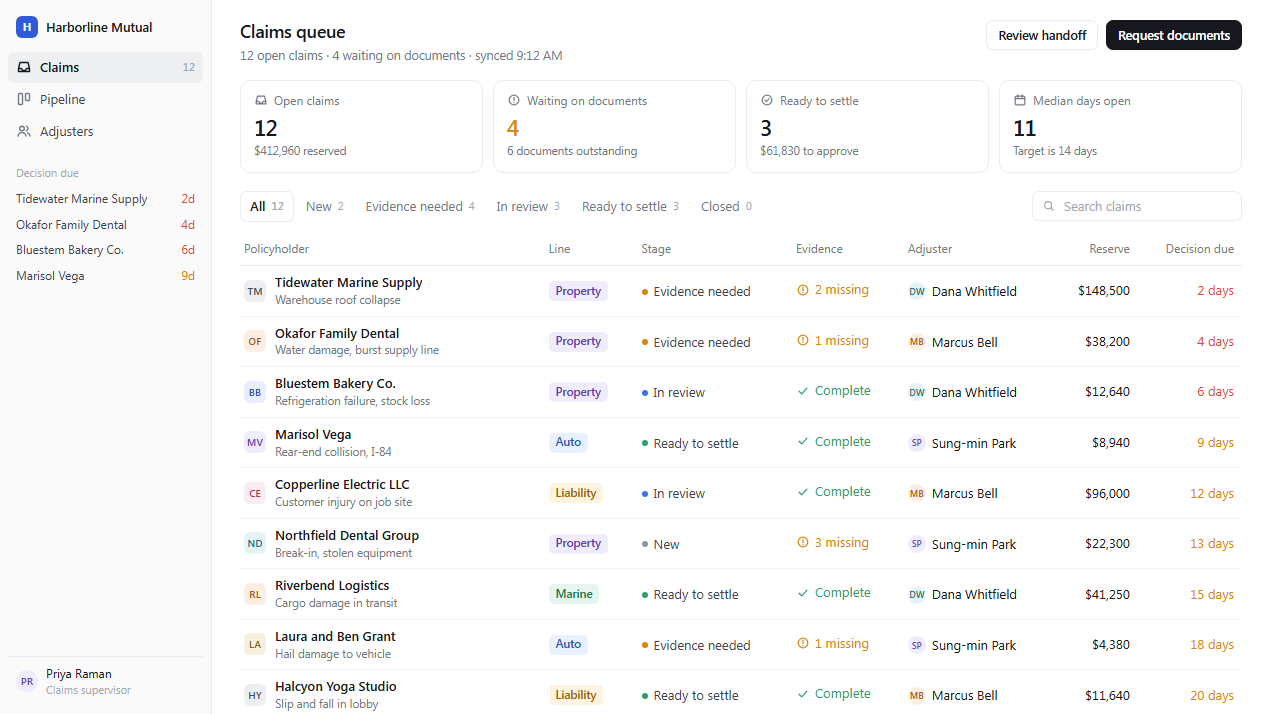
The claims review desk template shows the full queue.
Frequently asked questions
Does Snapsheet's AI find missing documents?
Snapsheet's AI page does not say so in those words. It says WatchDog "creates (and assigns) a review task when the file falls short", and that review tasks can be limited to claims whose outcome is at risk or outside your guidelines.
What AI does Duck Creek offer for claims?
Its claims page describes Agentic First Notice of Loss, with "intelligent, conversational intake and automated workflow orchestration", and Document Intelligence for turning unstructured documents into data and workflows.
What does Guidewire ClaimCenter offer for intake and triage?
The source we used is the ClaimCenter brochure published in 2020, which describes adaptive first notice of loss and analytics deployments for claims triage, severity escalation, and subrogation detection. The brochure does not describe these as AI features. Ask Guidewire for its current AI features.
Can Siftree write to Guidewire, Duck Creek, or Snapsheet?
No. Siftree has no connector for those systems. It reads evidence from email, document stores, and DocuSign, and drafts or sends document requests. Your adjusters record decisions in the claims system.
Do we have to replace our claims system?
No. The platform stays the record. An agent layer only makes sense for evidence that arrives outside it.
Sources & methodology
Product details and supporting references used in this guide.

Co-founder, Siftree
Kyle co-founded Siftree after working in data across telecom, media, insurance, automotive, and entertainment and tourism. He writes Siftree's software comparisons and buying guides from the vendor documentation linked in each article.
See it with your own workflow.
Connect your agent, or have us build around your team's workflow. Bring the data you use, the work you want done, and where the result should go. We'll scope the app and required access with you.