
World Economic Forum 2026 Quantitative Analysis
World Economic Forum 2026 Quantitative Analysis
Case Study
Feb 11, 2026
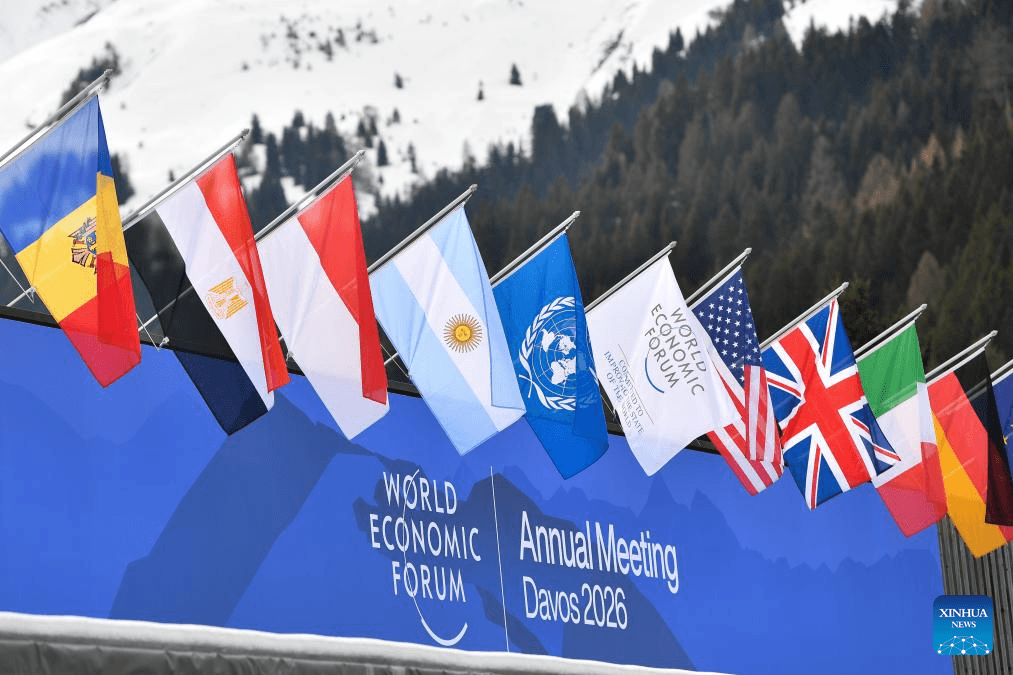
We analyzed thousands of hours of videos posted by the World Economic Forum to extract predominant narratives promoted by world leaders.
Davos
Every year, the eyes of the global elite turn to the snow-capped peaks of Davos, Switzerland, for the World Economic Forum (WEF). Founded in 1971, the WEF is an international non-governmental organization that serves as the premier stage for the "global village"; a gathering place where heads of state, CEOs of multi-billion dollar corporations, and leading intellectuals meet to shape the global, regional, and industry agendas.
But why does this gathering matter to the average person or the global market? Because the WEF serves as an incubator for the narratives that dictate future policy and economic shifts. From the "Great Reset" to the evolution of AI governance, the themes discussed in Davos often serve as the blueprint for legislation and corporate strategy over the following decade.
By analyzing thousands of hours of video footage from the 2026 summit, we have used Siftree’s data capabilities to extract the most predominant narratives promoted by world leaders, providing a clear, data-backed view of the "Davos Consensus" and what it means for our collective future.
Process
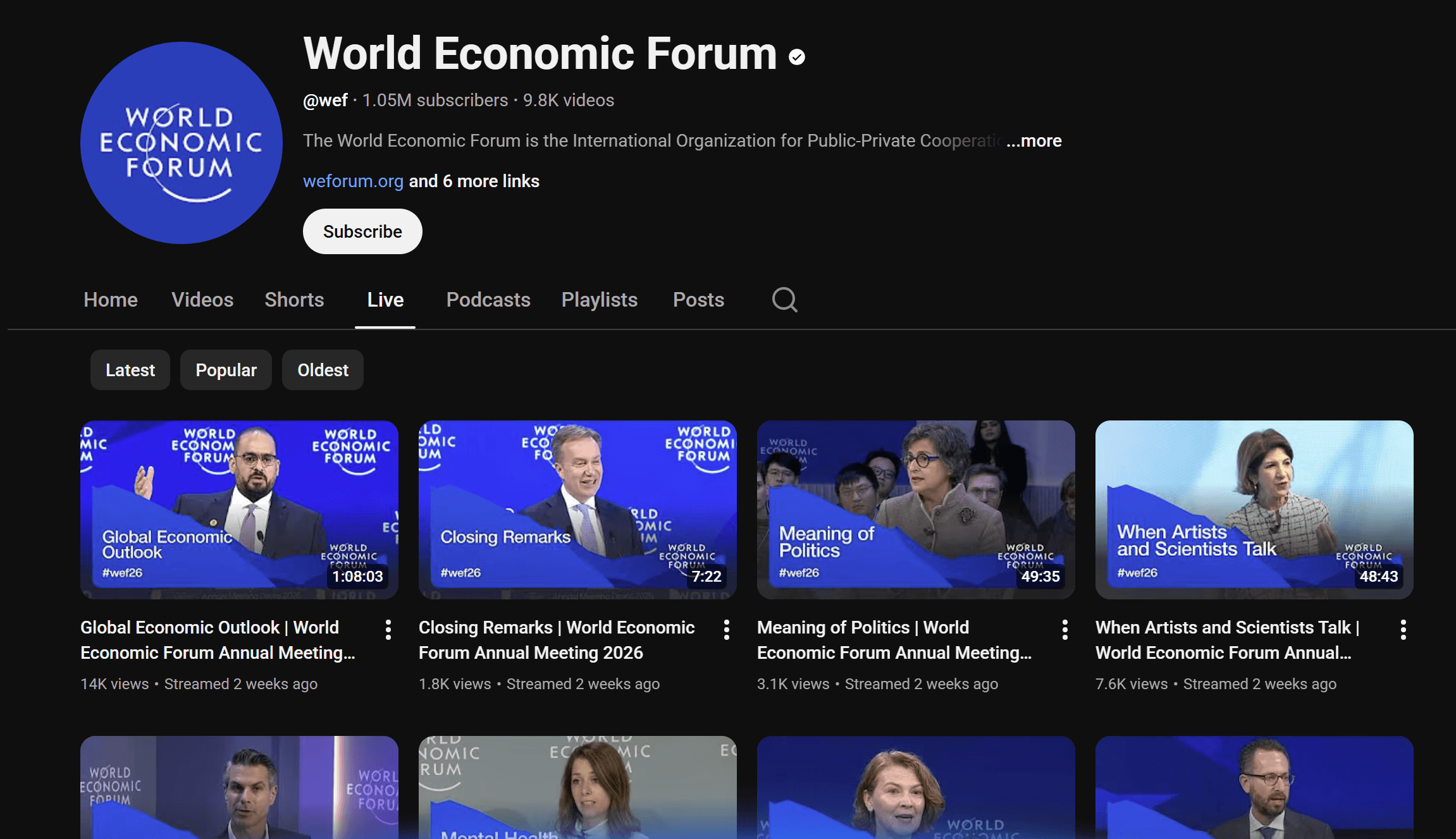
We partnered with industry-leading audio transcription AI lab, Babbl Labs to accurately transcribe thousands of hours of videos. We then ingested these transcriptions into Siftree, giving us a concrete understanding of what the most dominant themes were in Davos.
Results
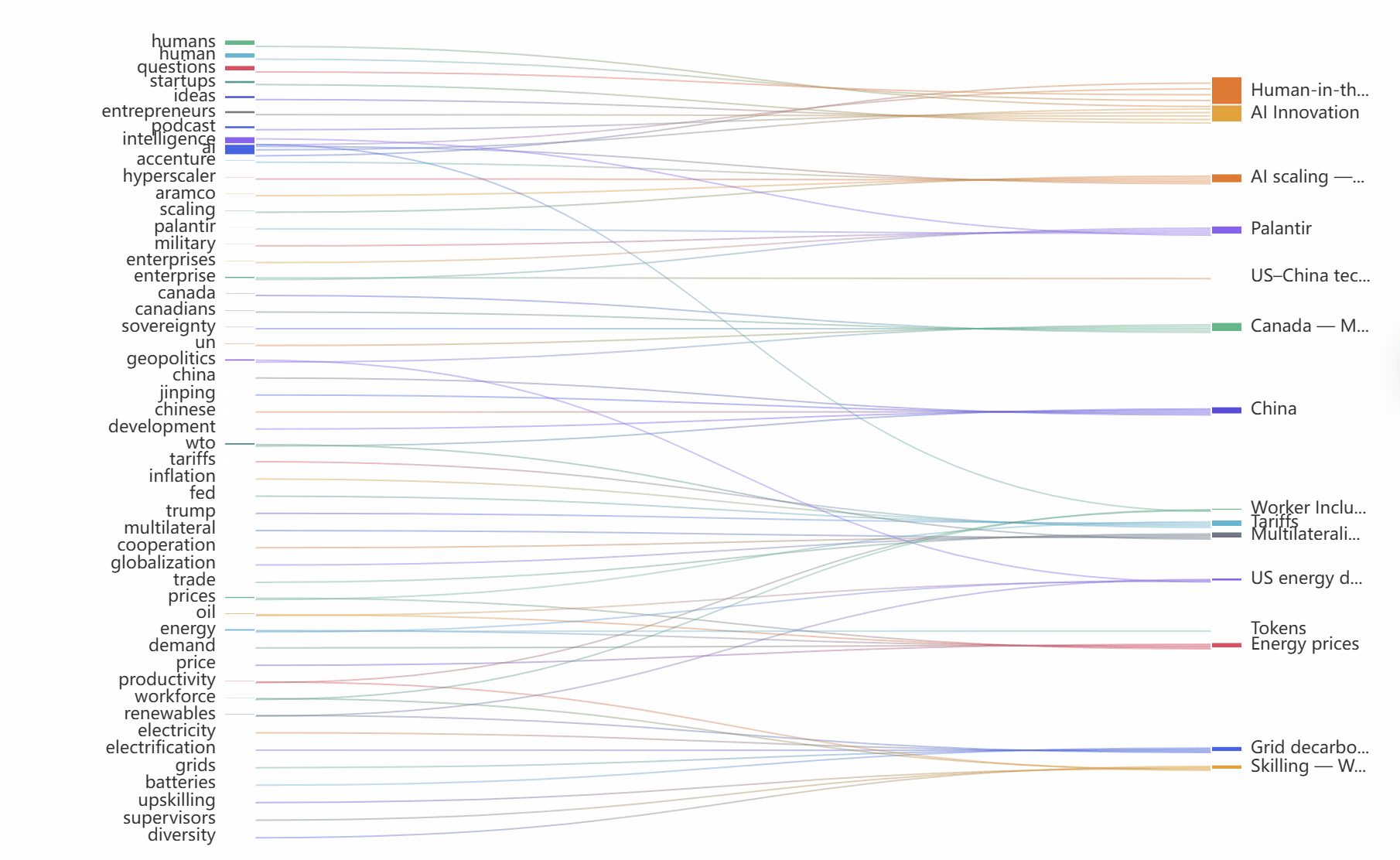
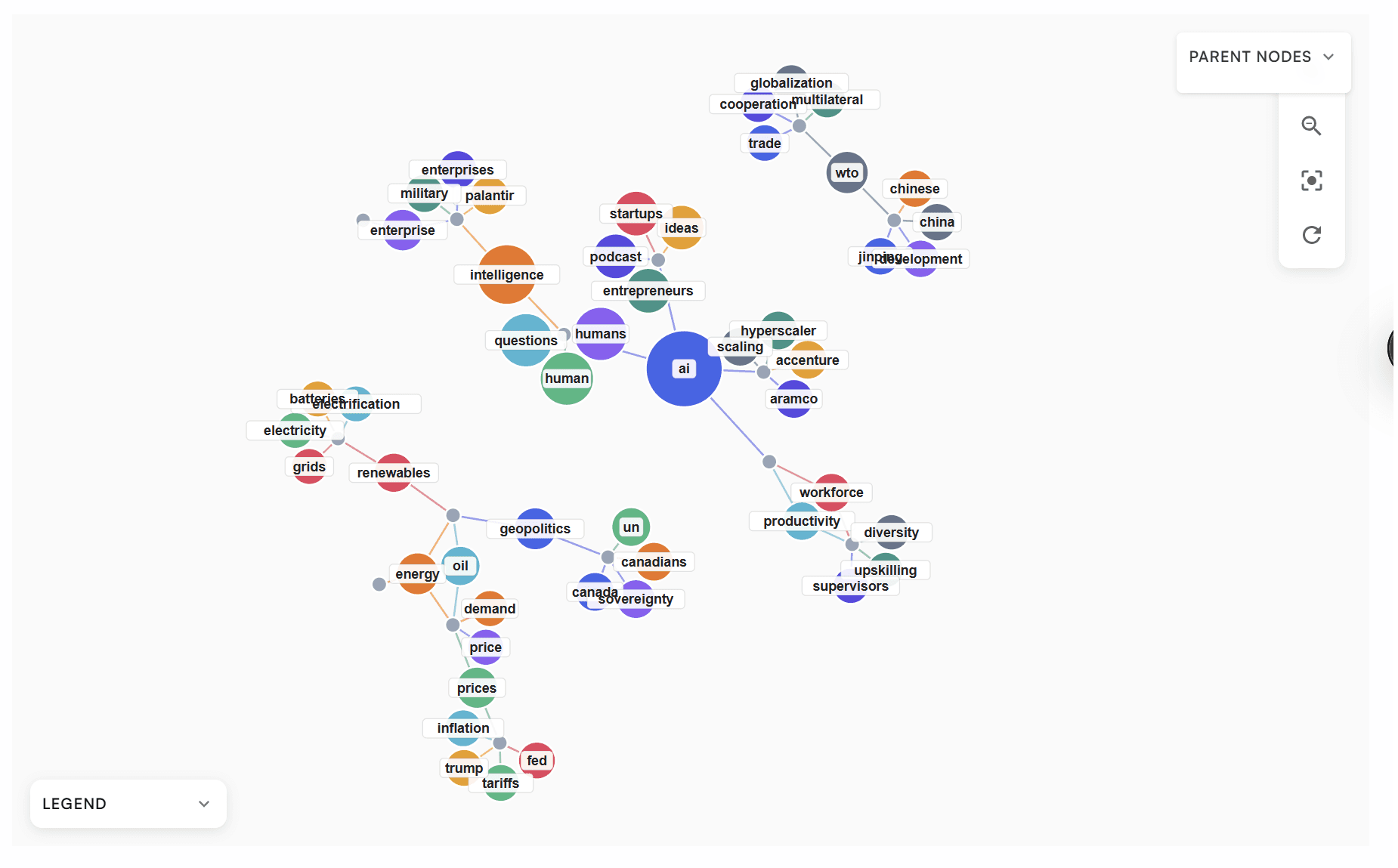
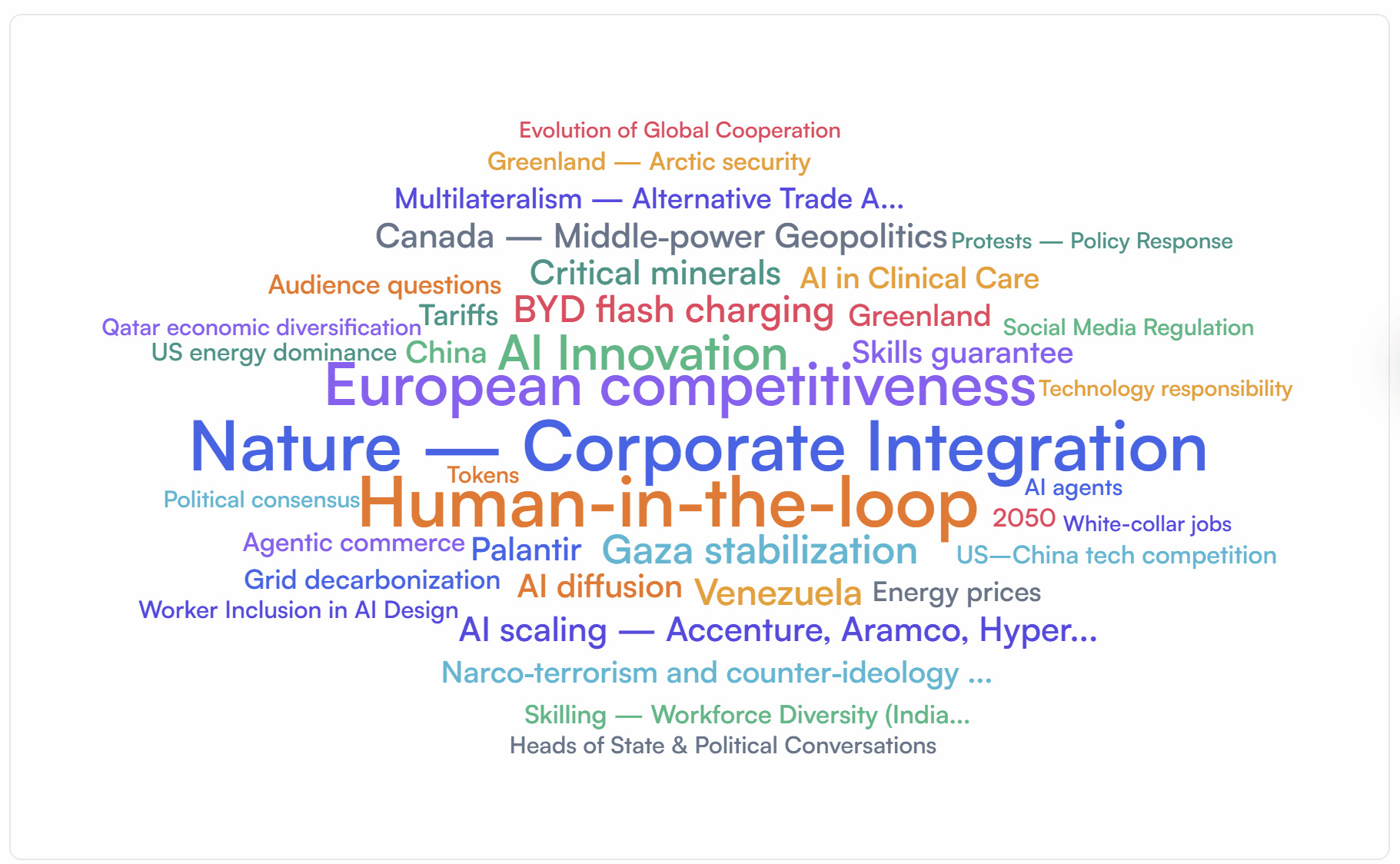
Takeaways
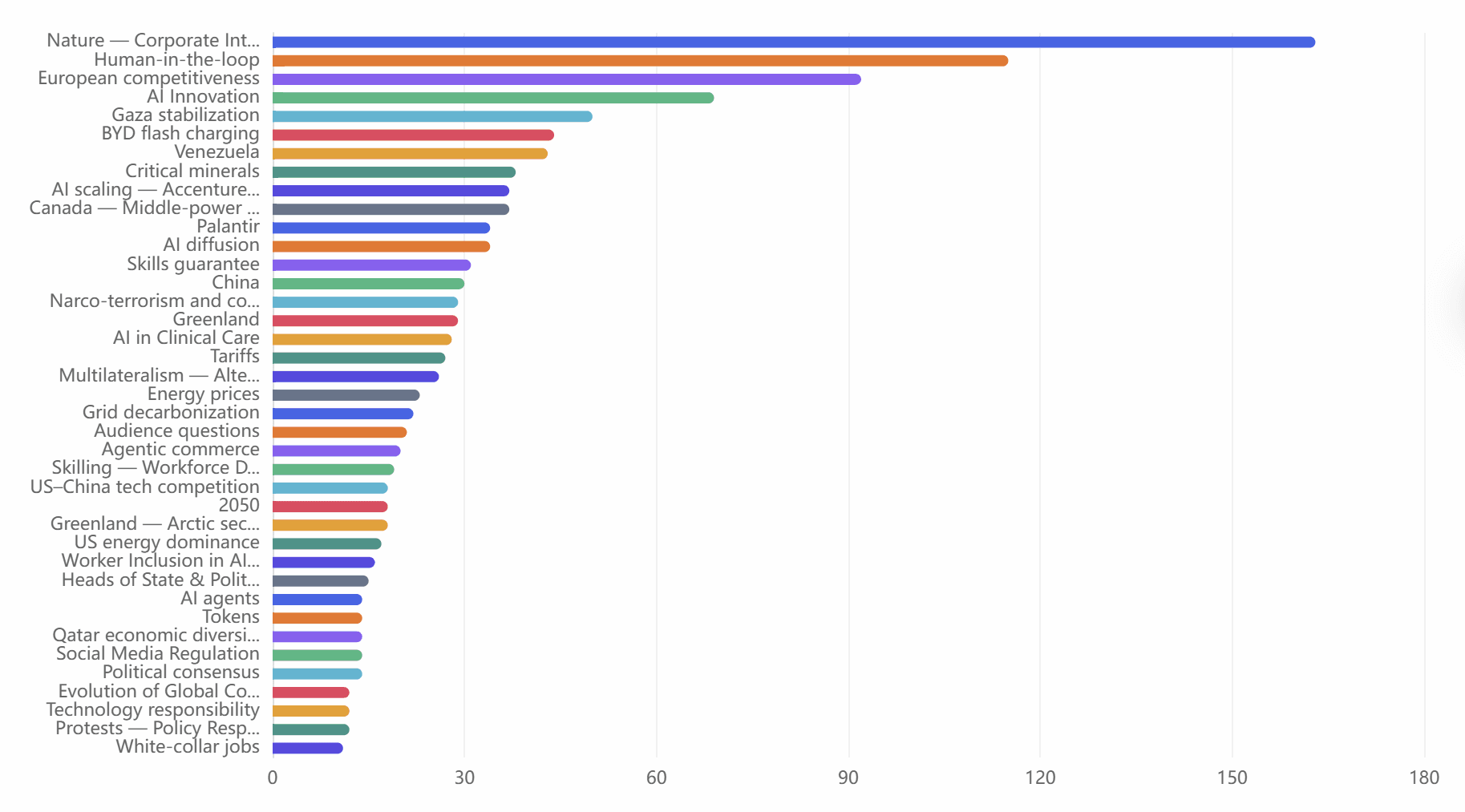
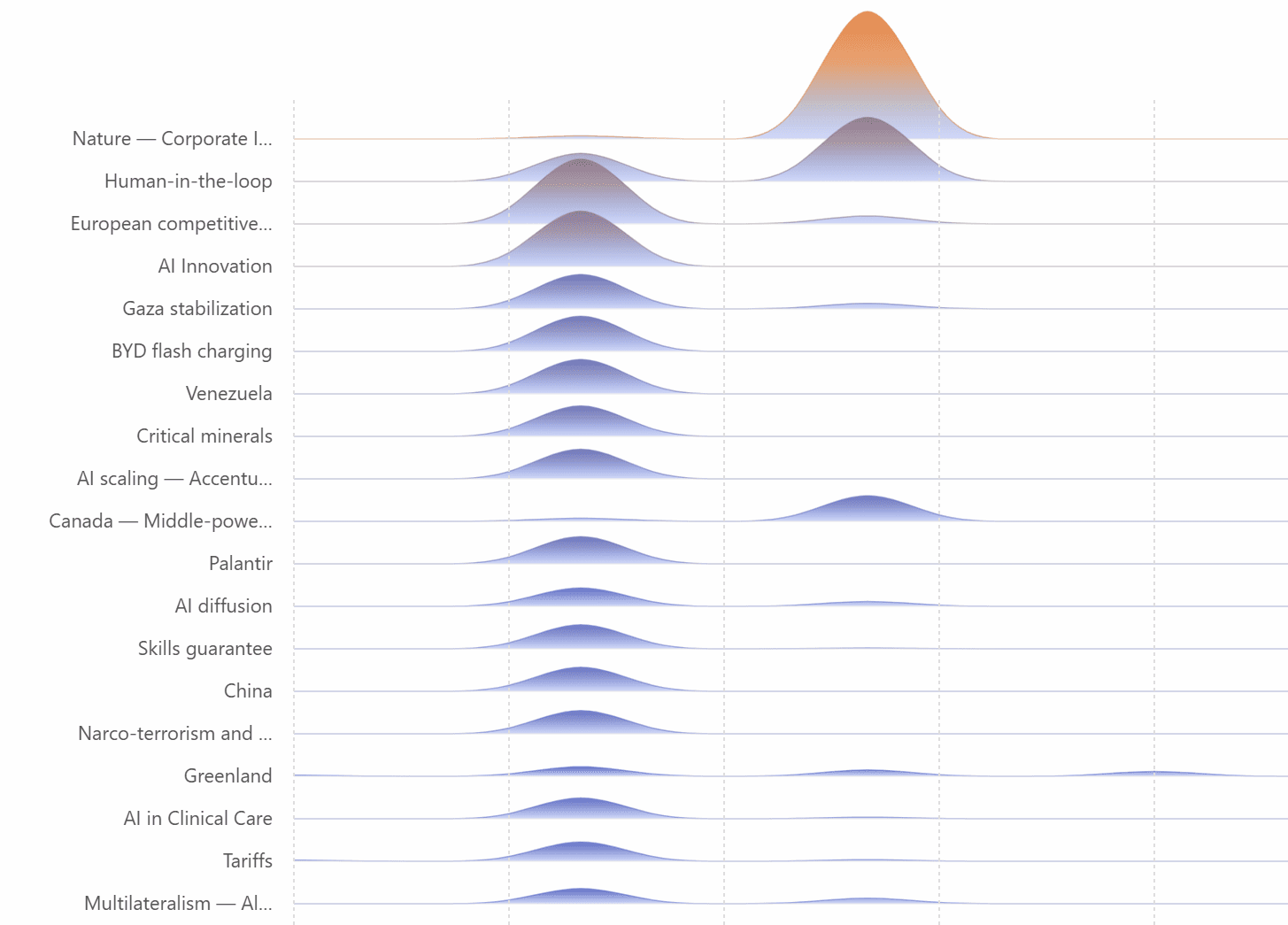
The Financial & Physical Reality of Sustainability: The sustainability narrative has graduated from "moral pledges" to hard economics and industrial engineering. The data shows a shift toward accounting for nature as a financial liability and solving the physical bottlenecks of both the green and AI transition simultaneously — specifically the refining of critical minerals (which now drive 60% of battery costs) and the deployment of "flash charging" infrastructure alongside data centers. Securing the raw materials and grid capacity to survive the next industrial cycle is top of mind.
The "Human-Anchored" AI Scale-Up: The AI conversation has moved from "magic" to governance and operational reality. The high volume of "Human-in-the-loop" discussions signals a refusal to let AI loops close without oversight, prioritizing safety over raw speed. Simultaneously, the focus has shifted to application: using AI to "give time back" to clinicians, scaling from pilots to enterprise-wide systems and preparing for a future of "Agentic Commerce" where trust is the primary currency via smart contracts and tokenization.
Realpolitik & "Strategic Geography": Geopolitics has become intensely transactional and location-specific. We are seeing a return to "Strategic Geography," where specific territories (Greenland for the Arctic "Golden Dome," Gaza for regional stabilization, Venezuela for resources) are the focal points of global security. The data suggests a move away from broad multilateralism toward specific "deals" — using US energy prowess as a foreign policy tool and stabilizing specific regions to secure supply chains and borders.
The Race for Industrial Sovereignty: The era of open globalization is being replaced by regional fortresses. Europe is anxiously trying to build a "Capital Market Union" to stop its slide into irrelevance, while the US and China are locked in a "tech stack" rivalry (Nvidia vs. Huawei). The prevalence of topics like "Tariffs" and "Alternative Trade Arrangements" indicates that future commerce will be conducted through "coalitions of the willing" and protectionist barriers rather than open global markets.
Future Outlook: From Ideals to Infrastructure
The data from the 2026 summit signals a definitive end to the era of "globalization by default." What we see in the Siftree analysis is a shift toward calculated pragmatism. The "global village" is no longer just debating abstract risks; it is actively building the infrastructure to survive them.
As we move toward 2027, the "Davos Consensus" suggests three critical shifts that will redefine the competitive landscape:
The Sovereign Resource Race: With minerals and energy prices now dictating 60% of industrial costs, "sustainability" has been rebranded as "security." We are entering a decade where geopolitical power is measured by Arctic influence and refining capacity rather than just GDP.
The Trust Economy: As Agentic Commerce begins to replace human browsing, the they will need stable rails and automatic processes; see tokenization and new protocols. Companies that can prove their AI agents are reliable, human-centric, and secure will own the next generation of the market and engage in autonomous commerce.
The Rise of the "Middle Power" Stabilizer: The data highlights a world where traditional superpowers are increasingly deadlocked, leaving a vacuum for countries like Canada and regions like the Arctic to act as the new centers of diplomatic and resource gravity.
The Bottom Line: The 2026 summit proves that the future belongs to those who can bridge the gap between AI-driven efficiency and the hard realities of physical resource security.
Want a copy of the full analysis? Contact Us and we'll be in touch!
World Economic Forum 2026 Quantitative Analysis
We analyzed thousands of hours of videos posted by the World Economic Forum to extract predominant narratives promoted by world leaders.
Recent articles:
World Economic Forum 2026 Quantitative Analysis
Using Siftree to Increase LinkedIn Followers by 900%
The future of social networks
Analyzing the TikTok Acquisition

Nostr vs. AT Protocol (Bluesky): a complete guide
Davos
Every year, the eyes of the global elite turn to the snow-capped peaks of Davos, Switzerland, for the World Economic Forum (WEF). Founded in 1971, the WEF is an international non-governmental organization that serves as the premier stage for the "global village"; a gathering place where heads of state, CEOs of multi-billion dollar corporations, and leading intellectuals meet to shape the global, regional, and industry agendas.
But why does this gathering matter to the average person or the global market? Because the WEF serves as an incubator for the narratives that dictate future policy and economic shifts. From the "Great Reset" to the evolution of AI governance, the themes discussed in Davos often serve as the blueprint for legislation and corporate strategy over the following decade.
By analyzing thousands of hours of video footage from the 2026 summit, we have used Siftree’s data capabilities to extract the most predominant narratives promoted by world leaders, providing a clear, data-backed view of the "Davos Consensus" and what it means for our collective future.
Process
We partnered with industry-leading audio transcription AI lab, Babbl Labs to accurately transcribe thousands of hours of videos. We then ingested these transcriptions into Siftree, giving us a concrete understanding of what the most dominant themes were in Davos.
Results
Takeaways
The Financial & Physical Reality of Sustainability: The sustainability narrative has graduated from "moral pledges" to hard economics and industrial engineering. The data shows a shift toward accounting for nature as a financial liability and solving the physical bottlenecks of both the green and AI transition simultaneously — specifically the refining of critical minerals (which now drive 60% of battery costs) and the deployment of "flash charging" infrastructure alongside data centers. Securing the raw materials and grid capacity to survive the next industrial cycle is top of mind.
The "Human-Anchored" AI Scale-Up: The AI conversation has moved from "magic" to governance and operational reality. The high volume of "Human-in-the-loop" discussions signals a refusal to let AI loops close without oversight, prioritizing safety over raw speed. Simultaneously, the focus has shifted to application: using AI to "give time back" to clinicians, scaling from pilots to enterprise-wide systems and preparing for a future of "Agentic Commerce" where trust is the primary currency via smart contracts and tokenization.
Realpolitik & "Strategic Geography": Geopolitics has become intensely transactional and location-specific. We are seeing a return to "Strategic Geography," where specific territories (Greenland for the Arctic "Golden Dome," Gaza for regional stabilization, Venezuela for resources) are the focal points of global security. The data suggests a move away from broad multilateralism toward specific "deals" — using US energy prowess as a foreign policy tool and stabilizing specific regions to secure supply chains and borders.
The Race for Industrial Sovereignty: The era of open globalization is being replaced by regional fortresses. Europe is anxiously trying to build a "Capital Market Union" to stop its slide into irrelevance, while the US and China are locked in a "tech stack" rivalry (Nvidia vs. Huawei). The prevalence of topics like "Tariffs" and "Alternative Trade Arrangements" indicates that future commerce will be conducted through "coalitions of the willing" and protectionist barriers rather than open global markets.
Future Outlook: From Ideals to Infrastructure
The data from the 2026 summit signals a definitive end to the era of "globalization by default." What we see in the Siftree analysis is a shift toward calculated pragmatism. The "global village" is no longer just debating abstract risks; it is actively building the infrastructure to survive them.
As we move toward 2027, the "Davos Consensus" suggests three critical shifts that will redefine the competitive landscape:
The Sovereign Resource Race: With minerals and energy prices now dictating 60% of industrial costs, "sustainability" has been rebranded as "security." We are entering a decade where geopolitical power is measured by Arctic influence and refining capacity rather than just GDP.
The Trust Economy: As Agentic Commerce begins to replace human browsing, the they will need stable rails and automatic processes; see tokenization and new protocols. Companies that can prove their AI agents are reliable, human-centric, and secure will own the next generation of the market and engage in autonomous commerce.
The Rise of the "Middle Power" Stabilizer: The data highlights a world where traditional superpowers are increasingly deadlocked, leaving a vacuum for countries like Canada and regions like the Arctic to act as the new centers of diplomatic and resource gravity.
The Bottom Line: The 2026 summit proves that the future belongs to those who can bridge the gap between AI-driven efficiency and the hard realities of physical resource security.
Want a copy of the full analysis? Contact Us and we'll be in touch!