Review a competitor price change against your margin floor
How to decide whether to match a competitor's lower price: check the variant and offer terms, work out your margin at the matched price, and route anything below the floor to the merchandiser who owns it.

How do I review competitor price changes against my margin floor before repricing?
Treat a lower competitor price as a decision only when the offer is comparable and likely to last. First confirm the variant, size, and offer terms match; a clearance, bundle, or seasonal promotion is not a list-price change. Then work out your gross margin at the matched price and compare it with your floor. Anything below the floor goes to the merchandiser who owns the product, with the offer and the arithmetic attached. This changes when the lower price holds across later observations; then the question is your floor, not the offer.
What Siftree is: an AI-native IT department for your team. Describe the outcome through your existing AI connected over MCP, and we manage data integration, the data and AI platform, app and agent cloud, and security. This article compares platforms from their public documentation; check the sources, plans, and integrations against your own requirements.
A lower price is not yet a decision
When a competitor drops below you, the tempting response is to match. Check three things first: is it the same product, what are the offer terms, and what would matching leave you? A variant mismatch, a temporary offer or a price below your margin floor can each require a different decision. The reviewer needs those facts together before choosing a response.
Siftree prepares that review. It watches public product offers and the competitor product URLs you approve on a schedule, reads your price from Shopify, BigCommerce, or WooCommerce, checks it against the product cost and margin floor your team sets, and compares the matching variant. Your team decides whether the price changes. This workflow is about that single decision; to set up the monitoring itself, see how to monitor competitor prices with AI.
The table follows one change through the three checks.
| Check | Question it answers | Woven cotton throw |
|---|---|---|
| Variant | Is it the same product, colour, and size? | Yes: clay, 130 × 170 cm on both listings |
| Offer terms | Is it a list price or a temporary offer? | Clearance at $59 while stocks last |
| Margin at the matched price | What would matching leave us? | 13.6% gross margin, against a 35% floor |
| Owner | Who decides? | Jules Martin, merchandising manager |
From a competitor's new price to a recorded decision
The observation arrives on schedule
A scheduled check records the competitor's public offer with the time it was observed and the listing text. A failed check stays a failed check, never a price drop.
The agent matches the variant
It compares colour, size, pack, and included components with your listing. If the variant differs, the review says so instead of comparing unlike products.
It reads the offer terms
Clearance, seasonal promotions, bundle pricing, and delivery charges are pulled from the listing and shown beside the price, because each one changes what matching would mean.
It works out your margin at the matched price
Using your current price and the product cost your team sets, it shows the gross margin you would keep at the competitor's price and whether that clears your floor.
It routes the review to an owner
Changes below the floor, or above the review threshold you set, are assigned to the merchandiser for that category and raise an alert, with the offer and the arithmetic attached.
The merchandiser decides
Approve a recommended price, set a different one above the floor, or hold the current price. Any price change is made in your store by your team.
The next observation closes the loop
After an approved change, the next observation confirms your store shows the new price before the review moves to monitoring and closes.
The woven cotton throw, worked through
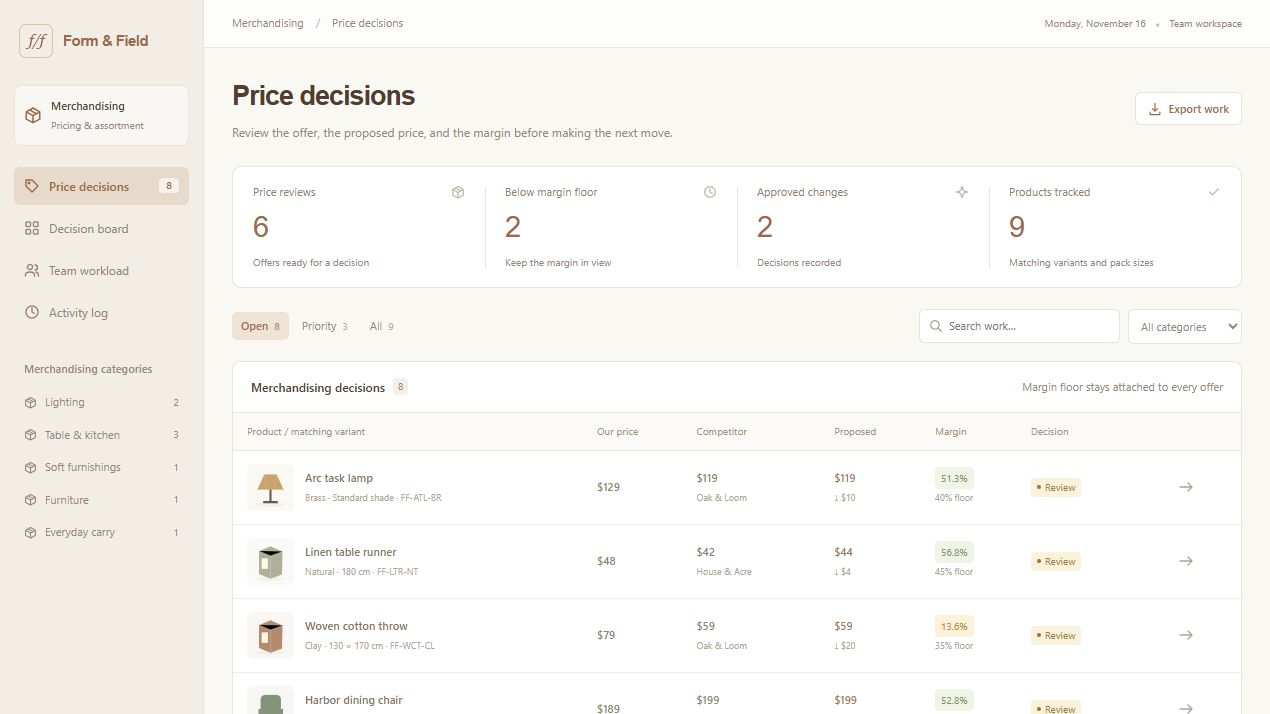
Form & Field sells its woven cotton throw in clay, 130 × 170 cm, for $79. It costs $51, so today's gross margin is 35.4%, just above the category's 35% floor.
Oak & Loom lists the same throw, same colour and size, at $59. The variant check passes. The offer terms do not: the listing calls it a clearance offer while stocks last, a stock-clearance price rather than a sustained list-price change.
Matching would leave $8 on a $59 sale, a 13.6% gross margin. The floor allows almost no room at all: at a $51 cost, the lowest price that holds 35% is $78.47. So the review reaches Jules Martin flagged high priority, titled as a competitor match that would fall below the margin floor, with the listing text, the observation time, and the margin calculation attached.
Jules has two sound choices: hold $79 while the clearance runs, or trim no lower than $78.47, which gains little against $59. Matching $59 is not one of them unless the floor itself is being reconsidered, and that is a merchandising decision, not a pricing reflex.
The same board shows why offer terms matter. A $29 carafe offer applies only when bought with a set of four tumblers; the standalone price is $39. Matching the headline would compare a bundle with a single item.
Which competitor price changes need a merchandiser today?
The product pricing monitor's price decisions, each with our price, the matched competitor offer, the recommended price, the margin check, and an owner, moving from review to approved, monitoring, and closed. Connect your Shopify, BigCommerce, or WooCommerce store and choose the competitor products to watch.
See the full product pricing monitor template and the retail competitor price monitoring page.
Checklist · 0 of 7
Before you approve a price change
Every review should carry these before anyone decides. If one is missing, the review is not ready.
For choosing between this kind of review and automatic repricing, see competitor price monitoring for a Shopify store. For whether monitoring can keep running between conversations, see Can AI monitor competitor prices?.
Frequently asked questions
Does Siftree change our store prices?
No. The pricing workspace prepares comparisons and review thresholds. Your team decides whether a pricing change should be made and makes it in your store.
Where do the cost and margin floor come from?
Your price comes from your connected Shopify, BigCommerce, or WooCommerce store; product cost and the margin floor come from merchandising, set for each product or category.
What if the competitor's listing is a different size or variant?
The review says the variant differs and does not treat the price as comparable, so it does not prompt a match.
What happens when a price check fails?
A failed collection is kept separate from a price change, so it does not appear as a new offer or a sudden discount.
What if the lower price keeps appearing in later observations?
Review the later offer terms and the margin floor again. Repeated observations can justify another decision, but do not by themselves prove that a temporary offer has become a permanent list price.
Sources & methodology
Product details and supporting references used in this guide.

Co-founder, Siftree
Kyle co-founded Siftree after working in data across telecom, media, insurance, automotive, and entertainment and tourism. He writes Siftree's software comparisons and buying guides from the vendor documentation linked in each article.
See it with your own workflow.
Connect your agent, or have us build around your team's workflow. Bring the data you use, the work you want done, and where the result should go. We'll scope the app and required access with you.